Sunday, April 26, 2015

ENTERTAINMENT - NO COVER

There's so much more to the state of Louisiana than famous New Orleans.   What most tourists don't know about is central Louisiana, where they have the same delicious triple by-pass food and foot-stomping music.   Called the land-less-traveled, the small towns and back roads of central Louisiana offer bona fide Cajun and Creole culture in an unpretentious and slower-paced setting.   And add to that the restored centuries-old plantations with their controversial history and the alligator-filled swamp life in the bayous, and you have a destination that is worthy of a visit.   Even the words Cajun and Creole have different definitions here, depending on where you are, who you ask and what color he or she may be.  

The genesis of our trip

Ever since my visit to New Orleans and the start of my infamously- aborted bicycle ride up the Mississippi River (hence my blog's URL),  I have bugged Bruce about going to New Orleans (NOLA). My harping fell on deaf ears until six months ago, when he read an article in an issue of National Geographic Traveler about an area in Louisiana that offered good food, great music and a cultural component as well.  Northwest of NOLA, this area could be best described as Cajun, Creole and cowboy country.  "I'd love to do this trip some time," Bruce said, as he handed me Andrew Nelson's article to read, hoping I would have the same positive reaction he had.  Exploring central Louisiana would take us off the beaten tourist track, and expose us to a different landscape and a unique culture, aspects that both of us crave when we travel.

One of Bruce's many talents is developing an itinerary and bringing it to life, so with that in mind, our good friends Karen & Barry came along, making it even more fun.   Although we were too late for Mardis Gras and too early for Jazz Fest,  New Orleans was enduring another crazy time called spring break.     I could write a separate post about our two days and three nights there, but let's just say that after two days of gustatory debauchery, we headed northwest where we immediately felt the essence of a much quieter life.  With Barry behind the wheel and Bruce as his co-pilot, we stopped often, took lots of pictures, talked to quirky people, and read crazy signs. 


Our menu at Cochon, a popular restaurant in NOLA
  

Is it hot enough for ya?

Did you ever wonder where Tabasco sauce comes from?   Well, we did, so we visited McIlhenny's, the fifth-generation family company that produces more than 700,000 bottles of the famous hot sauce every day when the operation is full up and running.    In my growing up days in the Granite State,  we had our mouths washed out with soap when we swore or talked back to our parents.  Here in Louisiana, kids might get a dose of tabasco instead.   The factory is located on Avery Island, 170 acres of sprawl with its very own bird sanctuary where  thousands of egrets love to hang out.  Many of the live oak trees  have an unusual posture, with moss-ladened branches hugging close to the ground. 


LOUISIANA LIVE OAKS ON AVERY ISLAND

EGRETS NESTING


Cajun Central

The charming college town of Lafayette, 150 miles northwest of NOLA, has many things going for it, and we experienced the top three, beginning with a delicious dinner at Prejeans,  a traditional Cajun restaurant with the best dessert of the week;  tasty bread pudding with white chocolate sauce that Karen and I shared and devoured, with our two spoons rapidly moving toward the center, so that neither of us got more than our share.   One dish at the next table caught our eye -- a Shrimp Festival Platter -- a three course meal of shrimp salad, shrimp gumbo, a platter of grilled, stuffed, fried and blackened shrimp, served with a shrimp butter cream sauce for dipping with a side order of french fries and rice.   Rather than showing offense at my overt reaction, the man being served seemed amused.  "Where y'all from?" he asked.   "You mean you came all the way from San Francisco to eat at Prejeans?"    He shook our hands and introduced us to the group around the table.  "Here's my wife, my two daughters, my nephew, my grandson, and a granddaughter.  My granddaughter here is about to deliver our first grandchild," and then with a big smile he went on to say "she's married."  "My parents didn't have any money, so they put me on an orphan train and a Louisiana family adopted me.  Pleased to meet y'all, and enjoy your time in Lafayette."   

PREJEANS

SHRIMP FESTIVAL PLATTER

NEVER SAW A SIGN LIKE THIS BEFORE


A men's clothing store on Jefferson Street called Right on Fashion sold what some people might call pimp clothes -- every color-of-the-rainbow shoes, some patent leather, some two toned;  chartreuse and bright orange men's suits, and hats for every occasion.  When we saw the flashy display in the window, we knew we had to go in.


PERFECT, BARRY


TO GO WITH BARRY'S ORANGE SUIT


 Lafayette's Blue Moon Saloon has become a premier venue for local music.   Located in a funky house with a hostel upstairs, Blue Moon has live music every night.  We had planned to be there on a Wednesday, the night when local musicians come from near and far to jam.   There is no food.  Only beer.  And no cover.   By the time we arrived, the small main room was already crammed with beer-drinking locals, gathering close to the slightly raised platform where the musicians were tuning up.  I counted 15 of them; some were standing off the edge of the platform, which was not big enough for everyone who wanted to play.  There was no announcement and no introductions.   I saw every string instrument I can think of,  plus a few Cajun extras, like an accordion, a triangle and a washboard.   The music was so infectious that it was impossible to stand still, but there was no way I could move my feet like that.  Cajun dancing is a true art form.  It may be called many things, but I say it's an exuberant two-step, where the footwork is more like a jitterbug than the West Coast swing.   All of the folks we talked to were happy to meet us.  You mean you came all the way from San Francisco to hear music at the Blue Moon Saloon.  


The next day we drove the scenic route to Nachitoches (pronounced Nakatish--don't ask me why), a small town whose claim to fame is the movie Steel Magnolias, which was filmed there.  Our plan was to have a meat pie lunch at Laysones, which is described by restaurant authors Jane and Michael Stern as "One of the 500 things to eat before it's too late."  The drive to Nachitoches wasn't that far, but the guys were having so much fun at the Right on Fashion store in Lafayette that by the time we started driving north, it was already past noon and Laysones closed at 3.    

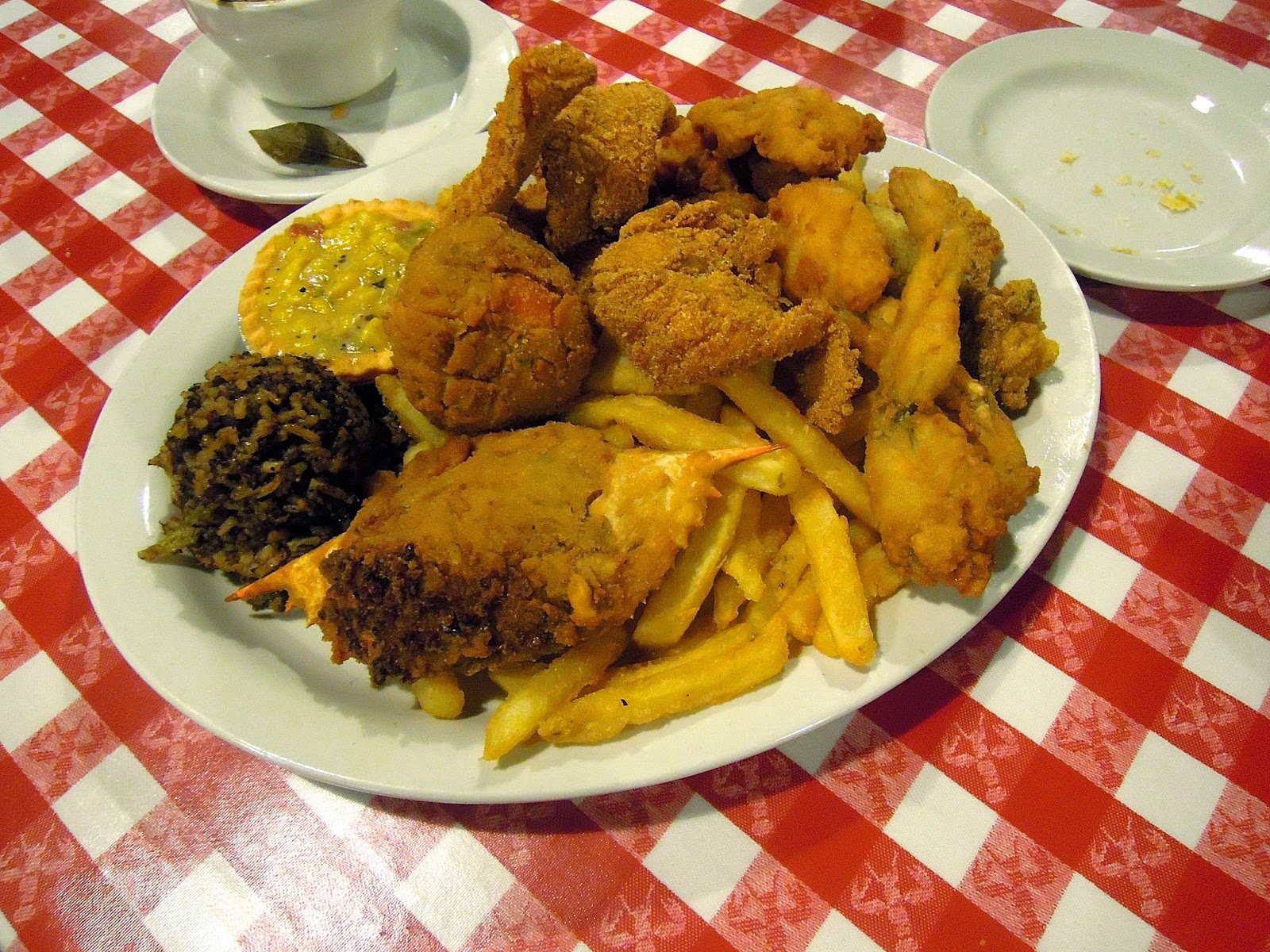
Even with a map and three GPS devices, finding Laysones had a few problems, as each device gave us different directions.  In the backseat, Karen and I were not much help since we were in hysterics as Barry made one U-turn after another.  "We are going in circles," Karen hooted, as I crossed my legs and prayed to God we'd arrive at Laysones by three.   Not only was I hungry for a meat pie, but I needed a bathroom urgently, and the last thing Barry needed to hear was: Can we find a bathroom?  At 2:45 we walked into Laysones, passing framed photos of visiting celebrities, and asked "Are we too late?"    "No problem," said Helen, our excellent server, who Barry said looked just like.........   "You look like Liza Minnelli," Barry exclaimed, and immediately Helen was in Barry's pocket.  "You mean you came all the way from San Francisco to eat our meat pies?"  We didn't deny this, despite our indecisions about what to eat.   Helen patiently crossed out several orders when one dish sounded better than the other. "Yes, we'd all like a meat pie, but will that be enough? "  We were starved.  After all, we hadn't eaten since breakfast and the clock said 3 pm.   Three meals a day was de rigueur.   "Maybe we should order a meat pie, a crawfish pie, and a bowl of gumbo just to be sure." And a side order of fries, which seemed to be the only vegetable so far in this part of the state.    For those who don't know, a Louisiana meat pie is like an empanada, except it's deep fried.  The operative word here is deep fried.  Need I say more?


Bruce and Karen checking out Laysone's menu
    
Delish!


Our B&B in Nachitoches


We made another friend in Nachitoches besides Helen.   David was sitting at the local bar when we walked in.  I don't know whether the khaki pants that Bruce and Barry were wearing tipped him off, but David definitely spotted us as tourists and wanted to become instant friends.  When he heard we were from California, he told us about how he fell in love with redwood trees when he visited Muir Woods.    He also mentioned a serious brain injury he incurred from a bicycle accident, and after a few drinks together, Barry and I wrote down his Natchitoches address and promised to send him a California redwood tree.   Have you done this yet, Barry?


Stay tuned.  The adventure continues................


Sunday, April 5, 2015

CLOSER TO THE BONE, THE SWEETER IS THE MEAT

Some of our California friends wondered what possessed us to take a trip to Texas. They might have asked the same question if we had said we were going to Arkansas or West Virginia because these U.S. states are not our usual destinations. Most of the time we take long overseas flights to experience unusual sights and exotic cultures, but this time we could accomplish the same thing by just going to Texas.

We had been advised that the 20 minute drive from Austin out to Lockhart for barbecue at Kreuz's was worth it, so we went. Now I know why my friend laughed when I asked if we needed reservations. From the outside, Kreuz's reminded me of a big-old-fashioned dance hall, like the kind we had in New Hampshire in the 50s and 60s, when I was growing up. It was 7 pm when we arrived, and because there were a series of large empty rooms, none of which looked much like a restaurant, we weren't sure where to go or how to order. Eventually we found ourselves in the smoke room where there was a large chalk board listing the meats sold at prices between $14 and $17 per pound.


"We're out of everything except pork chops and sausage, and maybe a couple of beef ribs," said the tired-looking woman standing next to the scales. "We're out of beef and chicken and brisket. What a crazy day." Granted it was Good Friday and the start of a busy weekend, but there were only a few trucks in the parking lot (like big hair, big trucks are ubiquitous in Texas) and the cavernous dining room looked pretty empty.


"I'll have a pork chop and a sausage, " I said. "Me too," said Bruce, and a couple of pieces were thrown on to several thick sheets of brownish pink butcher paper, wrapped loosely, and tossed our way. "You can git drinks and sides through those double doors over there," the tired lady said, as she weighed the meat, rang up twenty two bucks, and pointed in the direction of the doors. Once on the other side, the woman selling sides and drinks said they were out of potato salad, mac and cheese, and coleslaw but still had red cabbage and pinto beans. "Ok, two beans and two cabbages and a couple of beers," we replied, wondering why their supply was so limited at 7 pm. "Maybe people eat early in Texas," I said, as I looked around the nearly empty fluorescent-lit dining hall, and saw only a few families eating pork chops and sausages too. Oh and I mustn't forget. There were no plates. You ate off the butcher paper and there were no forks. Only plastic knives and spoons, which meant we ate Tom Jones style, although the spoons came in handy for the sides. In addition, the large role of paper towels was a perfect substitute for napkins, but I could have used some dental floss too.


The adventure continues............


Posted using BlogPress from my iPad

Wednesday, April 1, 2015

TEN DAYS, TEN POUNDS

There are certain words, names and images that come up when I think of the State of Texas.  Thinking positively, there was Molly Ivins, the great newspaper columnist and political commentator, Ann Richards, an outspoken feminist and the 45th Governor of Texas, the movie Giant, an epic portrayal of a powerful ranching family starring Rock Hudson and Elizabeth Taylor,  Big Bend National Park,  my first birding experience with Lynne Aldrich when she lived in Houston, and the Tex-Mex town of El Paso, where my mother-in-law used to live. 


Big Bend National Park (with thanks to National Geographic for the photo)


 Unfortunately most of my negative thoughts about Texas are politically based:  George Bush, Rick Perry, Ted Cruz, Ron Paul, legislation to ban gay marriage, and a hardline stance on immigration, gun control and abortion.  Just typing these words gives me the heebie jeebies.

And yet, when I get on a plane tomorrow, I'll be heading east and landing in Texas.  We are not staying long.  Just time enough for a quick breakfast in the state capitol, see and photograph the famous Blue Bonnet wild flowers made famous by Lady Bird Johnson, give a big hug to Lea, an Australian friend, who is riding her bicycle across America and just coincidentally will be in Fredericksburg, Texas the same night we will, and to have dinner in San Antonio with a wonderful friend I went to high school with in Maine.  


Blue Bonnets of Texas


After Texas, we'll fly to the Big Easy,  the famous city of New Orleans, Louisiana where, along with good friends, we will see as many sights as we can cram into two days, eat as much shrimp, oysters, crawfish Ã©touffée, jambalaya and beignets as our stomachs will hold, listen to great music like lil Red and Big Bad at the Balcony Music Hall, Marcia Ball banging away at those keys, and checking out the NO Music Exchange on Magazine Street.  

And after NOLA, we'll drive north along the Cane River to a city whose named is spelled Nachitoches but pronounced Nakateesh, where they are known for their amazing southern hospitality and their empanada-like meat pies.  We'll find time to tour the famous Tabasco factory on Avery Island, attend the annual Strawberry Festival in Ponchatoula, and a blues festival in Baton Rouge. 


I'm telling you this now, so you can keep an eye out for some photos and descriptions of what's to come.

Stay tuned.  The adventure continues....................

Friday, March 13, 2015

HIKING IN THE PINNACLES NATIONAL PARK

I have traveled all over the world, but why is it that I've never been to one of nature's greatest gifts that sits in my own backyard?  

This is something one of my Facebook friends asked when I posted a photo of Bruce and me hiking at the Pinnacles National Park. Although the newly-designated National Park is only a two hour drive from our house, neither of us had ever been there, and I've lived in California for close to fifty years.


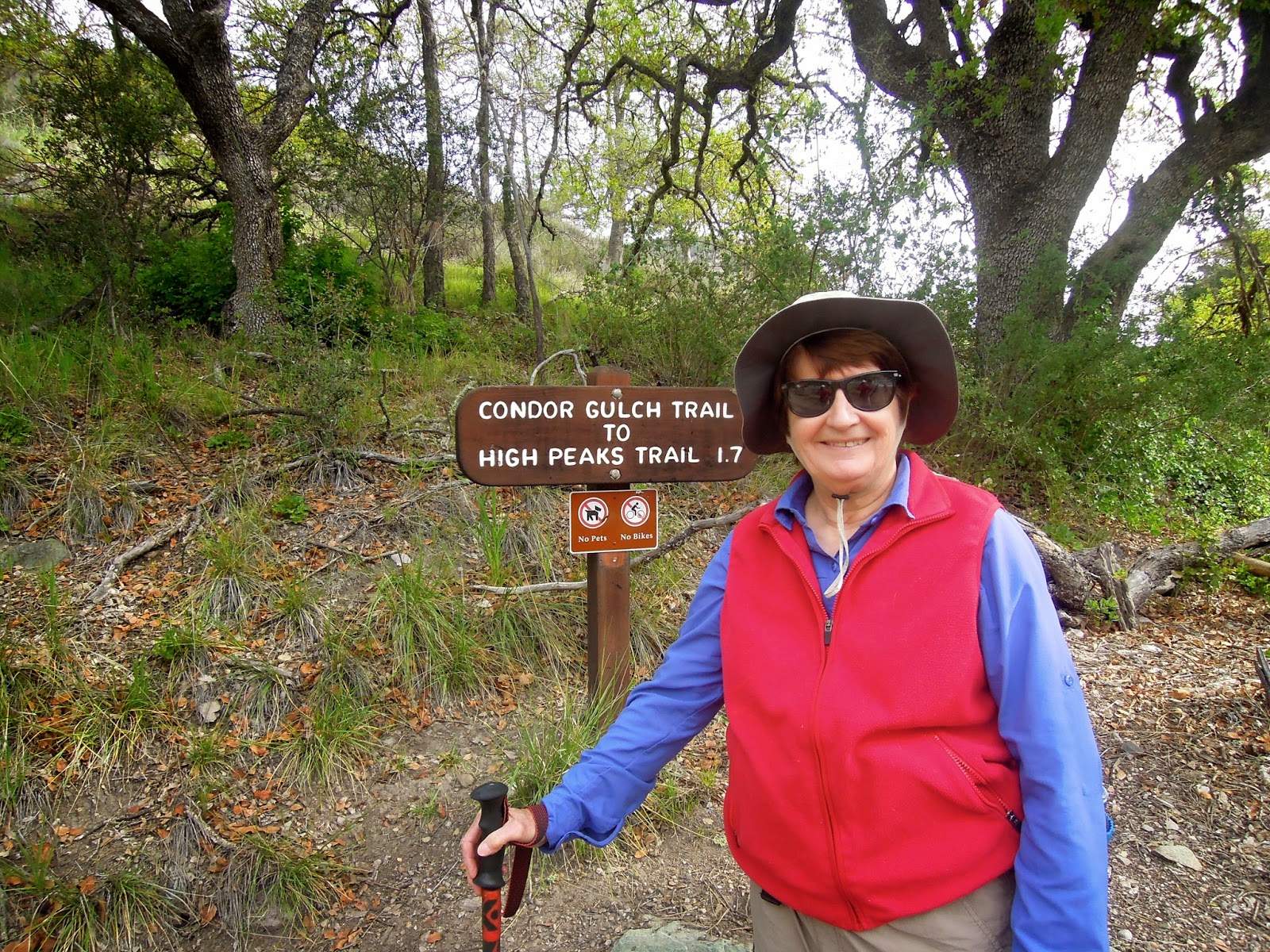
Located just south of Hollister and east of Soledad, the Pinnacles National Park consists of eroded leftovers of an extinct volcano that over thousands of years moved almost 150 miles from where it was originally sited on the San Andreas Fault to where it now sits near  the Salinas Valley.  The park can be accessed from both the East side and the West side, but the only way you can travel within the park itself is on foot, hiking on beautiful trails through a series of large boulders and huge colorful rock formations that in some ways reminds you of our country's beautiful Southwest.  As you will see in the pictures included with this post, some of the trails are scary, precariously sited on the steep edges of rock formations, especially if you hike the famous High Peaks Trail.  


Ever since last summer when hiking became a weekly activity for me, I have wanted to organize a group trip to the Pinnacles, but choosing the right time of year to go is critical.  Spring is definitely the best time, if you want to see an abundance of wild flowers.  The air is cool and perfect for hiking.  Also, if you are fortunate enough to visit during a rainy winter season, when we are not in a drought like we are now, you would witness multiple waterfalls cascading down the beautiful red and black volcanic rock.   However, summer months can be brutal as temperatures often climb into the high 90s, and since there is little shade within the park, hiking can be quite uncomfortable and even dangerous. 


photo by Bob Yee


Finally, last week Bruce and I plus a group of six friends arrived at the Pinnacles for a hike led by Lynette, a veteran Pinnacles hiker, whom I was fortunate to meet last fall at a travel presentation.   When she talked about her extensive hiking experience,  she also mentioned her love for the Pinnacles.  I told her of my interest in getting some friends together to hike there, so she generously offered to be our leader and take us through a maze of trails, so that we could have the best hiking experience that the Pinnacles has to offer.   We also hoped to see the adult and juvenile condors that live within the park, but since early morning and sunset are the best times for viewing, we weren't sure we'd be so lucky to see them on this trip.  


Leslie

Bob and Shannon

Connie


Photo by Bob Yee


The weather on March 10th was ideal for hiking, especially since our very dry winter and now dry spring has also been unseasonable warm.   Luckily for us the sky was overcast, and the temperatures ranged in the low 70s.   After discussing our hiking options, we all agreed to take on the challenge of the High Peaks Trail, knowing that if we couldn't climb those rocks this year, we probably would never do it.   I had watched a YouTube video of some folks climbing the High Peaks Trail, and it looked pretty scary, especially for someone, like me, who has a fear of heights.  On the other hand, I knew that it was just mind over matter, and that as long as I held on tight to the iron railing bolted into the rock for protection, and if I walked slowly and carefully, I'd be o.k.   

Around 10:30 a.m.,  we began our ascent on a dirt but slightly rocky trail that was not as difficult as I expected, especially since Lyn warned us that the first half mile was pretty steep.   Although we were just a little ways out of the valley, the views looking out were beautiful.  I thought this might be a trip I'd blog about, so I took out my small point and shoot camera and began snapping away.  After taking about 20 nondescript photos, I was stunned to see the message out of memory show up on my camera screen.  Since I don't use this camera that often, I charged the battery the night before and even noticed a message that said no images in camera.  What the hell? I thought.  I looked inside my camera and saw that the chip slot was empty.  I couldn't believe I'd been so dumb, beating myself up as I saw one prize-winning photo opportunity after another, but couldn't take a picture. It seems that the twenty or so photos, most of them pretty bad, were captured on my camera's internal memory, and the internal memory doesn't have much space.  And stupidly, it didn't occur to me to erase the twenty lousy pictures, and capture some better scenery along the way.  Fortunately, other people in our group kindly agreed to let me use their photos in this blog. Thank you Bob Yee and Bob Ende. Anyway, enough of this camera crap talk and back to the hike.  


Photo by Bob Yee 


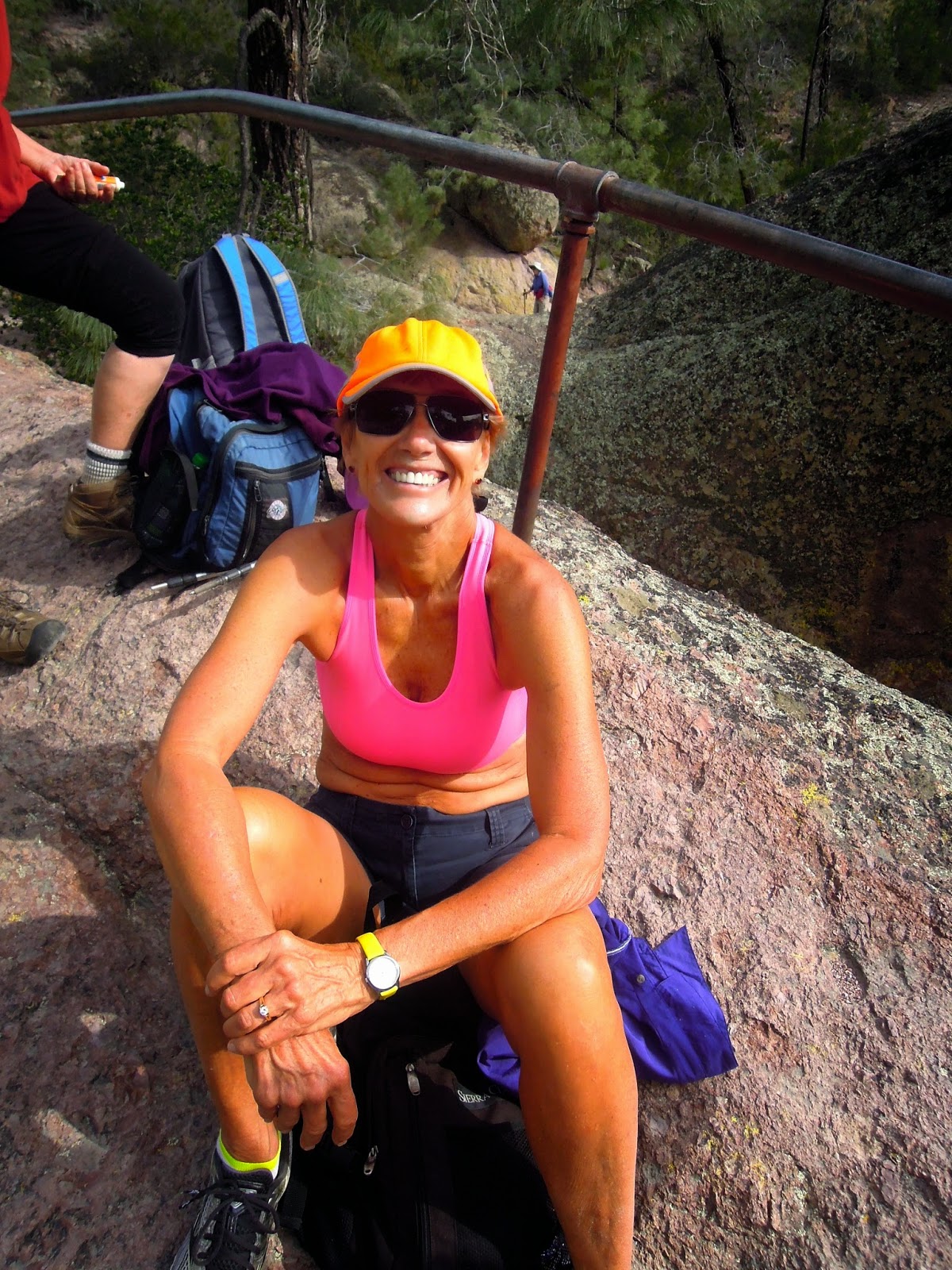
After walking uphill for about an hour, we came to the scariest section of the High Peaks Trail -- the portion I'd been really dreading -- climbing up the sides of pinnacles and boulders, either on medium-sized rock steps that had been placed one after the other on a steep trail of smaller rocks and then more steps that had been carved deep into the sides of the rock where we could take one small step at a time.  With each high step and each deep breath, I hung on to the iron railing that was securely bolted into the solid rock and looked straight down at my feet as I carefully ascended one step at a time.  I wanted to make sure that each foot was firmly planted on a rock step or placed squarely in the dugout step before continuing on.  


All climbing photos by Bob Ende


It wasn't as scary as I thought it might be, but it did remind me of the first time I discovered my fear of heights.  It was a few years back when I found myself standing precariously on a narrow ledge while hiking in Zion National Park.   I panicked and froze until I was brave enough to inch my way to safety with Bruce inching right behind me.  He wasn't any braver than I was, which made me happy that I had someone to share my fears with.   I was also reminded of the time I was driving solo in an ATV (all terrain vehicle) in Namibia, Africa at the precipice of one of the steepest sand dunes I'd ever seen and the guide telling me that there was only one way to get back to the camp and that was for me to take that mother of an ATV down the steep side of that soft sand dune.  When our guide saw the tears on my face and heard that god-awful wail, he knew that the only thing he could do was hold on to the back of my ATV with his hands and dig his feet deep into the sand to  slow my steep descent down that bleep bleep sand dune.    Compared to the fear-of-height experiences in Zion NP and Africa, climbing the High Peaks Trail at the Pinnacles was a piece of cake.


Once we reached the top, similar rock steps took us down the other side.  Again I held on to the iron railing until I reached safer ground, but the descent was pretty easy compared to hiking up.      Once we made it to a large ledge that offered safety and a fabulous view, we took out our home-made sandwiches from our packs and enjoyed our well-deserved lunch.   I'm sure the others had the same glorious feeling of accomplishment that I did, not to mention a sigh of relief -- the same sigh of relief I felt when I reached the bottoms of the canyon at Zion and the sand dune in Namibia.


image1.JPG
Photo by Bob Ende


After descending the precarious high peaks, the trail led us through tunnels of boulders and around green and red lichen covered rocks. While some hikers brought poles to assist them with steep pitches, I left mine at home thinking that a stick would only create problems for my already fragile shoulders.  That was a good decision because when Lyn gave me her second stick thinking it might be helpful, I realized it was more of a hassle than a benefit, especially when I needed two hands to keep myself steady. 

None of us knew what to expect in terms of the wildflowers.  We wondered whether our three years of drought might impact the abundance or perhaps we were too early or too late to get the flower show that others have raved about?  There were some beautiful flowers, but not a huge amount, but I did enjoy seeing a new flower called a shooting star which I had never seen before.  We came across a reservoir filled with water and walked through narrow rock tunnels and sulphur-smelling caves.  We also saw some young climbers hanging on the sides of steep pitches with their ropes and pitons.  We wished them well as we headed back down to the parking lot for a total of 7.5 miles of hiking.  We weren't able to assess our elevation gain, but my Fitbit said we'd climbed 181 floors.


Tuesday, February 17, 2015

HAIL MARY, FULL OF GRACE

Friends, it has been almost two months since my last post, which sounds a little like Father, it has been almost two months since my last confession, a reminder of the two years I spent in a Catholic school, although my family was not Catholic.    

Since my birthday is in the month of January, my mother worried that I would lose out if I waited until I was six and a half to begin first grade; therefore, she enrolled me at St. Rose of Lima, a private Catholic school in our town, when I was five and a half.  Fortunately, St. Rose didn't have an age requirement for starting first grade like the public school did, so my mother seized the opportunity to get me started a year early.   You see, back in 1949 there was no such thing as nursery school, pre-school or kindergarten, at least not in my town at that time.

Sister Paula, whom I adored, was my first grade teacher at St. Rose.   Although the person in this picture is not her, this is the type of clothing she wore -- a long black dress, black scarf which covered her back and all of her hair, and a white starched collar that came down to the middle of her chest.   


Sister Eunice taught me in second grade, and I remember loving her too.   Nuns were very kind as people, but tough as teachers.   I remember we all dreaded the black strap that was kept inside something called the blue box, which was a device we were threatened with.  Luckily, I never saw the inside of the blue box, but I did receive a few knuckle wraps with a wooden ruler for talking too much.  Punishment for this trait will not surprise any of my good friends.

I wanted to be a Catholic so badly, even knowing the negative feelings my parents had about Catholics generally.   I knew that any comments from me about this would upset them and could risk my being pulled out of that school.  It seems that there had been some discussion at home about whether enrolling me at St. Rose was the right thing to do.   We, as a family, never talked about religion or anything that smacked of God or a life hereafter, and the words heaven and hell were used only to describe the taste of a lemon meringue pie  or our reaction to a 12 inch snowfall in the middle of May.   In 1949,  my parents were only thinking of my academic education and not my religious one.   

Every morning at St. Rose,  we put our right hand over our heart and pledged allegiance to the flag.  We also recited Hail Marys, and read the Lord's Prayer until the words were memorized.   My parents were willing to go along with all of that, but nothing more, although I don't think they knew about the Hail Marys.  On Friday afternoons when the entire class was escorted across the street to attend confession at St. Rose of Lima church,  I sat quietly, alone at my desk and practiced my penmanship on paper, making sure my capital letters filled the space between the two black lines and the small letters only half way.  Every Friday I envied my Catholic classmates, who confided small blunders they called sins to a faceless priest, who sat enclosed in a box and promised God would forgive them.  I didn't understand what confession was all about because Catechism classes were taught outside of the classroom.  But I loved the idea of this regular religious ritual, and I really wanted to belong.   


Rose Marie Norman was my best friend at St. Rose of Lima


Then there were the shiny rosary beads.  Not only did I want to go to confession,  I also wanted to have my very own rosary beads, since I coveted the ones that my Catholic friends had.  Since I'm going back 60 plus years, my memory is a little fuzzy, but I do remember either finding or stealing some Rosary beads and calling them mine.   Unfortunately, I didn't have the beads for long because one day as I knelt down with beads in hand and began reciting Hail Mary, Full of Grace, my mother came in my room and caught me.   She snatched the beads out of my hands,  grabbed my arm, and yanked me downstairs to face the music. "Where did you get these beads?" she shouted at me.  "Where?"   Her face turned bright red when she said,  Your father is going to be very upset when he sees these." "Janie Roddy gave them to me," I replied, knowing that my lie was a sin that wouldn't get the forgiveness it deserved.  Janie and her five siblings came from a devout Catholic family who lived down the street, so she was the first Catholic person I thought of.  I whimpered I'm sorry to an unsympathetic mother.   She knew my father would not only be angry with me, but even angrier with her, after all enrolling me in Catholic school was her idea not his.  Daddy had little patience with the Catholic religion, which he saw as hypocritical, and, therefore, all practicing Catholics were hypocrites too.   Later, when I was old enough to understand, he often mentioned a Catholic couple he knew who went to confession on Friday, took holy communion on Sunday, but then the rest of the week they sinned like crazy, knowing that the following Friday they would confess and be forgiven again. 

  
By the time mother finally calmed down, I was begging her not to tell Daddy because even though I hadn't seen the inside of Sister Paula's blue box, I had felt the flat side of my father's big hand, and I didn't want to feel it again.  In those days the topic of whether to spank or not to spank was not written about or discussed in advice columns.   It wasn't that my parents didn't have a choice as to what type of punishment to impose.   It just seemed that spanking was more timely, and therefore the results would be immediate.  

Rightly so, my mother didn't believe the Janie Roddy story, but she didn't tell my father either.  Instead she decided the best punishment was for me to personally return the beads to Sister Eunice and tell her face-to-face how sorry I was.  It was not a pleasant experience, but I did it, and learned a good lesson as a result.

It was not a surprise when I transferred to the local public school and said goodbye to all my good friends at St. Rose.    Going to a new school didn't scare me because I was fortunate to have the beloved Mrs. Nutbrown as my third grade teacher, and making new friends was pretty easy for me.  Around the same time, my mother decided to send me to Sunday school at the Congregational Church, so that the thoughts of owning a pair of rosary beads and the words to Hail Mary could be extinguished from my little head.   My attendance was short lived because eventually I found church boring, and my mother did too. 

I don't know exactly why my father had these prejudices.  It wasn't just  about Catholics.  He had concerns about other religions and religious concepts as well.    As I have mentioned in previous posts, my father, who came to this country from Greece all by himself at the age of 14, didn't have any formal exposure to religion  except for the Greek Orthodox Church, which is about as close to Catholicism as you can get.   Although he never referred to himself as an agnostic or an atheist, I think  he saw religion as a kind of hocus pocus,  and the whole idea of there being a God who created the world or even a Jesus, who rose from the dead, seemed ludicrous to him.  However, a few months after he was diagnosed with cancer and only a few weeks before he died, he finally agreed to let the Greek priest in town come for a visit.  My mother said Daddy decided that if there truly was an afterlife, it was probably time to get in the queue.   Looking back and thinking more deeply about the lives of my immigrant parents when they were adults,  I wonder if their ill-conceived judgments were engendered by the prejudices they personally experienced as Greek immigrants living in a rural town that was filled with New England Yankees.  I was never told any specific stories that related to my father, although I'm sure there were some.  On the other hand, I do know that my mother was blackballed and denied entrance into the Eastern Star organization for reasons we were never told.  I'm sure my mother was terribly upset and hurt to be rejected so publicly.   When I heard this for the first time, I was grateful because I knew that neither African Americans nor Jews were allowed membership in the Eastern Star, which is a secret society for women associated with the Freemasons society for men. 

I know religion is a topic that we are told not to discuss because we might upset our friends.  When I started to write this blog, I had no idea what I was going to write about, but after the first two sentences, the words and stories came pouring out.  While I hope I don't offend my Catholic friends and family, like cousins and my grandchildren, I have found fewer and fewer Catholics who have remained steadfast to their religion, and some who have even left the church completely.   Although the weekly confessional is probably not on his list, I'm happy to see that Pope Francis is finally beginning to make changes in some of the defining elements of the Catholic church. 


Saturday, December 20, 2014

I MARRIED PHILEAS FOGG

I just put my husband on a plane to South Africa, where he will meet and travel with his youngest daughter, who has a two-week vacation from her refugee work in Kenya.  Although I was invited to go along, I opted to stay home and do something for myself, i.e.  take a break from travel.   Some of you who don't know Bruce will probably be surprised that a husband would leave his wife over the Christmas holidays,  but those of you who know him appreciate his love of travel, and how much he adores his kids.   And as I have written in a previous post, Christmas is not a big deal for us.   Christmas, Hannuka, Kwanza, Whatever. 


Compulsion or passion?

A friend recently emailed and mentioned that Bruce seems to have a compulsion to travel.   I wouldn't use the word compulsion to describe Bruce's desire to travel.   Instead, I would call it his passion.  The depth of his knowledge about art and history, and his curiosity about cultures and customs has always impressed me, so much so that I often feel I'm riding his coattails, both figuratively and literally, as we travel the world.    I often tell people I married Phileas Fogg, and for those who don't know the story, Around the World in 80 Days, by Jules Verne, the joke is lost on them.  

How did his passion start?

Bruce caught the travel bug when he and three of his college buddies spent 81 days touring Europe after graduation.   That whirlwind adventure whetted his travel appetite, so when there was some extra money, he used it for a trip somewhere out of the country.   His early working years didn't take him to exotic places. He went mainly to Germany where he had business relationships.  However, in the 1980s he had an opportunity to get involved business wise with a tall ship, a 165 foot, three-masted schooner called the Sir Francis Drake.  Built in 1917, the Drake was later reconfigured to function as a charter ship and sail throughout the beautiful Caribbean Islands.   Bruce's involvement in the business, doing accounting and some legal work, was very part-time, so rather than pay him a salary, the owner gave him free trips on the Drake.   That's when the notion of exotic travel began boring a little hole in his already travel-filled head.  


THE SIR FRANCIS DRAKE

And what about me?

In the '70s I made several trips to Europe with my ex-husband, using Frommer's famous guide book Europe on $5 a Day.  It was not quite backpacking, but close.  After those trips, most of my travel was back East to visit family and short trips around the West Coast, which was the most I could afford at the time. Although I felt quite worldly from the Europe experience,  traveling didn't affect me in the same way it affected Bruce.  For me it was a vacation, a time away from work, time to clean out my head.

 In 1999 when I met Bruce, I had just returned from a solo trip to New Zealand, where I biked part of the South Island and kayaked in the Tasman Sea.  I wanted to prove I could travel by myself.  This trip was so fun and rewarding that on my return flight, I made a list of other places in the world I wanted to go.  Of course, the countries I identified first were the usual ones in Europe:   Italy, Spain, Holland, the places I hadn't visited before.  It never occurred to me to consider far-out destinations, like West Africa, the Sepik River of Papua New Guinea, the Arctic Circle or Borneo.  I'm not even sure I knew where those places were, with the exception of the Arctic Circle.  That's the same as the North Pole, right?

What was our first trip together?


After a few weeks of dating, when I could tell Bruce was just a little bit smitten,  he asked if would I like to go sailing with him on a tall ship in the Caribbean.  My response to that invitation was the same answer I gave him two years later when he proposed marriage -- Are you kidding?  HELL, YES!   The trip also included two of his three daughters and a new son-in-law, which gave me insight into the close relationship he has with his girls.  We were dropped off at secluded beaches and small coral atolls you could swim around. We dropped anchor in island countries like St. Vincent, a volcanic island in the Southern Caribbean.  Most people have never heard of St. Vincent, but besides its tropical beauty, it's history is complicated --  first a French Colony and then later a British Colony, until its independence in 1979.   This trip exposed me to the Afro-Caribbean culture, their people's history, unusual food (think jerk chicken and conch soup) and the music of reggae singer, Bob Marley.


Bob Marley reincarnated


St. Vincent 


How did travel affect our relationship?

Long before the marriage proposal, but a year into the relationship, we took a two week driving trip in Italy.  Bruce saw this as a way to spend quality time with the woman he loved.  I saw it as a way to know whether this relationship was going to work out for the long term.   When couples have been in a relationship for at least six months, I offer this advice.   If you want to see how compatible you are with someone, take a trip together for at least two weeks.  By that time, the pretenses have fallen by the wayside,  little idiosyncrasies become apparent, and red flags pop up.   If you can make it through two weeks of 24/7 without pulling out your hair, then there's a pretty good chance the relationship will last. 

How do we get along 24/7?  

So,  another question is:  how much do Bruce and I have in common on the travel front?   Let's start with museums because there were plenty to see in Rome, Florence, and Venice.   As I've said before, Bruce has a high pain threshold for museums.  I enjoy museums too, but not six to eight hours a day.  This is some times a problem.   On the other hand, I have the ability to talk to people six hours a day, and while I wouldn't call it a problem per se, it's only because Bruce is a very patient man.  The other problem area relates to when we are driving because navigation is not my forte. While Bruce is patient about most things, my navigational skills, or lack thereof, is not one of them.  

On the positive side, Bruce is my history and art teacher.   I've learned more on the road with him than I ever did in the classroom.  Bruce credits me for giving him the gift of new friends, since I have no problem talking to strangers, and we've come home from a trip having made some really good friends.    Other positives:  We both enjoy traveling to out-of- the-way places, where only travelers go, not tourists.  When driving, we often take back roads because there's a better chance of seeing the unexpected.  We drink local brews and wine and seek out regional music in local bars and clubs, where we can hangout with townspeople.  We prefer to eat in small restaurants that serve authentic traditional  food.  We also enjoy the best restaurants in town, but a Michelin Star is not important because from our experience  Michelin food tends to be too precious   We also like soft adventure, but we like to know we have a place to sleep each night.   Searching for exotic treasures, like art, artifacts and local crafts, is also a shared interest, so much so our friends call our house a museum.  


The unexpected in NW Argentina


Bruce had an iron stomach in China 


An antique treasure we bought in Myanmar


Funny bathroom stories

On several occasions while traveling in Africa, we've had a bathroom with only a bucket and sponge for washing up,  but at least there have been Western toilets and not a hole in the ground.  I think the funniest bathroom situation was when we were in a hotel in China.   When Bruce was in the shower, I noticed a large gap in the tile and saw water pouring out onto the bathroom floor.  I yelled at him to turn the water off, and then together we tried to mop up the water with the only two towels we had.  When we realized we had a small lake in our bathroom,  I went to the front desk to report the problem and to ask for more towels or to have someone help us.   Frustrated by the fact that no one could understand or speak English,  I repeated slowly in pigeon English what it was we needed.   Finally, a woman nodded her head, but I quickly realized she wasn't getting my drift, so I took her to our room and showed her the standing water.   She looked down at the floor and nodded her head and then she left.  I assumed she was going to get help or at least get us more towels.  Ten minutes later she returned with a big smile on her face, and instead of towels, she  handed me a hair dryer and a shower cap, nodding as if to say will these help?   We were so amazed that there was nothing for us to do but laugh.  

Compromise?  Or do it my way

Neither one of us consider ourselves high maintenance, which is a good thing because someone who needs frequent attention wouldn't travel to some of the places we've been.    We have walked off our buns and scrambled over rocks to see important sights.  We both like to take pictures.  I take stills and Bruce takes video.  We are both interested in learning about different cultures and visiting places on the brink of change.   What is important and works for us is being flexible, spontaneous,  fairly easy going, adventurous, and having a good sense of humor.   There is one area that still gives me consternation.  I need to leave for the airport in plenty of time, just in case something happens along the way, and we are delayed.  I despise feeling rushed, and I some times worry I will miss the plane because of a backup on the freeway.  Bruce is much more casual about this and prefers to have about 10-15 minutes before boarding, so he can grab a cup of coffee.   Now that Bruce has experienced my airport anxiety, we do it my way.  


Scrambling down the Bandigara Escarpment to reach Dogon Country in the West African Country  of Mali


More Trips

After Italy in 2000, a wedding and Caribbean honeymoon on a catamaran in 2001, we took another giant step and did a safari in Southern Africa in 2003.  The American tour company we used made a couple of serious goofs in our itinerary, which could have complicated our trip if we hadn't noticed the inconsistencies in advance.  When we expressed concern, i.e. complained,  they upgraded us in such a major way that we stayed in ultra-luxury lodges run by an upmarket company called Wilderness Safaris (rack rate $1000 per night) and flew from camp to camp in their small private planes.  This experience would have been completely out of the question if it hadn't been for the goof.   Sadly, the tour company went out of business the following year.   We hoped our luxurious trip wasn't one of the reasons why.

After our safari, a young woman we met in San Francisco said, "Well, if you liked Africa, you should consider a trip to Papua New Guinea."   I knew of  PNG because I was acquainted with someone who had traveled there.  She showed me some amazing pictures,  and a few of the local treasures she brought home.  This background information was what inspired us to investigate and find a tour company that did trips there.   In 2004 we flew to Papua New Guinea and with a small group traveled up the Sepik River, visiting remote villages, experiencing an exotic culture, and meeting tribal people, who lived in primitive conditions in areas that are still difficult to get to today.   This trip exposed us to something truly out of the ordinary, and because of it, we wanted to do more.   Then we met other travelers who craved the same adventure and also wanted to explore remote areas of the tribal world.  This is how our soft adventure travel life began.  


PAM AND BRUCE IN PAPUA NEW GUINEA 2004


I have really benefited from Bruce's passion because I can now say I have traveled the world, although it's not about bragging rights.  I think I'm a different person because I have seen the world.    I am more adventurous and willing to explore countries and cultures that some people are afraid of or would never think of going to.   The trip to Papua New Guinea was definitely the first step in opening the door to a new way of thinking about future destinations.   Adventure travel is exciting, that's for sure, but we also covet our relaxing time at an all-inclusive called Club Med with family and friends, and believe it or not, we are actually talking about taking a cruise some time, but we have agreed that it has to be to somewhere exotic.