Monday, May 4, 2015

L'AISSEZ LES BONS TEMPS ROULEZ

The notion that I had to leave the United States to experience a new and authentic culture was debunked in Louisiana.  As most of you know, I have no hesitation about talking to strangers, and during some of those conversations, I felt like I was talking to folks from another country, and occasionally from a different planet.  It wasn't just that our world views were so different, like politics and religion, but it was more about lifestyle and economics.  

Many of the vehicles I saw on the road in Louisiana were trucks; some were  4X4s with oversized wheels so high you needed a ladder to climb up to get into that thing.  Legally, people may carry a gun in public places, but fortunately, I never saw one.  This area of Louisiana was definitely what I would call "redneck" country.   In some ways I felt I was back in the '70s, when people still ate cheese whiz on Ritz crackers and drank soda pop called Mountain Dew.   As a kid who didn't know better, I had some unfounded stereotypical opinions about Southerners.   I now realize it was the way they talked.  Yes, ma'am, and no, ma'am, sounded phony to me.   If I couldn't understand what they were saying, I blamed it on their ignorance, not mine.  For those southern belles I met in college,  I thought they were putting on airs.   Now that I know better,  I accept Southerners for who they are.  They may talk differently, but now I think of it as a charming accent. 


ANCIENT AS IT MAY BE,  THIS CASH REGISTER STILL WORKS 
      
HOW DO YOU GET UP IN THIS THING?


Early one evening while walking on a path along the Cane River (which is actually a lake),  Bruce and I met a man who, with his whole family in tow, was fishing for dinner right there in town.  They had everything they needed for a nice time -- lawn chairs set up looking out at the view, a six-pack of ice-cold beer, their fishing tackle, and a plastic bucket for the freshly-caught fish.    The man looked friendly enough, so we struck up a conversation, and he was interested to meet someone from our neck of the woods, since he had been to San Jose once.  "What's in that bucket over there?" I asked.  "Them are wauhms." the wife answered.  "They are what?"  I asked again.  "Wauhms."  After asking a third time, I peered into the bucket and saw creepy-crawly worms slithering around in all that dirt.   I never thought I'd say it, but I guess I can call myself a city girl.

 "How much does a one bedroom house cost ya out there anyway?" the fisherman asked.  "Well, we don't have many one bedroom houses," I answered, "but we have one bedroom apartments for rent."  "How much to rent?"   "I'm afraid to tell you," I said.  The man nearly fell over his fishing bucket when I told him $2500.   "Did you hear that, mama?" he shouted to his hard-of-hearing wife.  "$2500 a month.  That's five times what I make," he told me.  "That's why I didn't want to tell you, " I responded.  "Hey, you've got a nice life here next to this beautiful river, " I told the man,  but I'm sure he didn't live next to the river because all those houses were fancy ones, and $500 a month wouldn't buy him one of those.  But yes,  it looked like he had a nice life.  Definitely.


THE CANE RIVER, NATCHITOCHES, LOUISIANA 


WHAT THE HECK IS A MR. CRAPPIE?


I swear (pardon the pun) I didn't hear any bad language, except for the words that came out of the back seat driver's mouth when Barry made his third U-turn to find meat pies.   Most locals are religious, and the Catholic Church is the center of Creole life.  In this part of the country the Bible is number one on the best seller list.  Somewhere on the trip I heard a person say our California drought was predicted in the Bible.  I know there are plenty of religious people here at home, but not many are close friends.  Most people I know either go to Farmers' Market on Sunday or go for a bicycle ride. 


We visited several historic plantations in different states of preservation and learned about creole life two centuries ago. We heard fascinating stories and saw decaying evidence of what it was like to be a slave.   When you entered one of those tiny shacks and stood on the dirt floor where a family of eight slaves slept, you felt empathy and compassion for the hard lives they led.   The Prud'homme family, relatives of the renowned chef Paul, has deep roots in these parts, beginning in the 1700s when they moved to the Cane River area and became part of its diverse culture.   We also learned that plantation owners were the richest Americans at that time.


THE PRUD'HOMME FAMILY LIVED HERE


THE SLAVES LIVED HERE

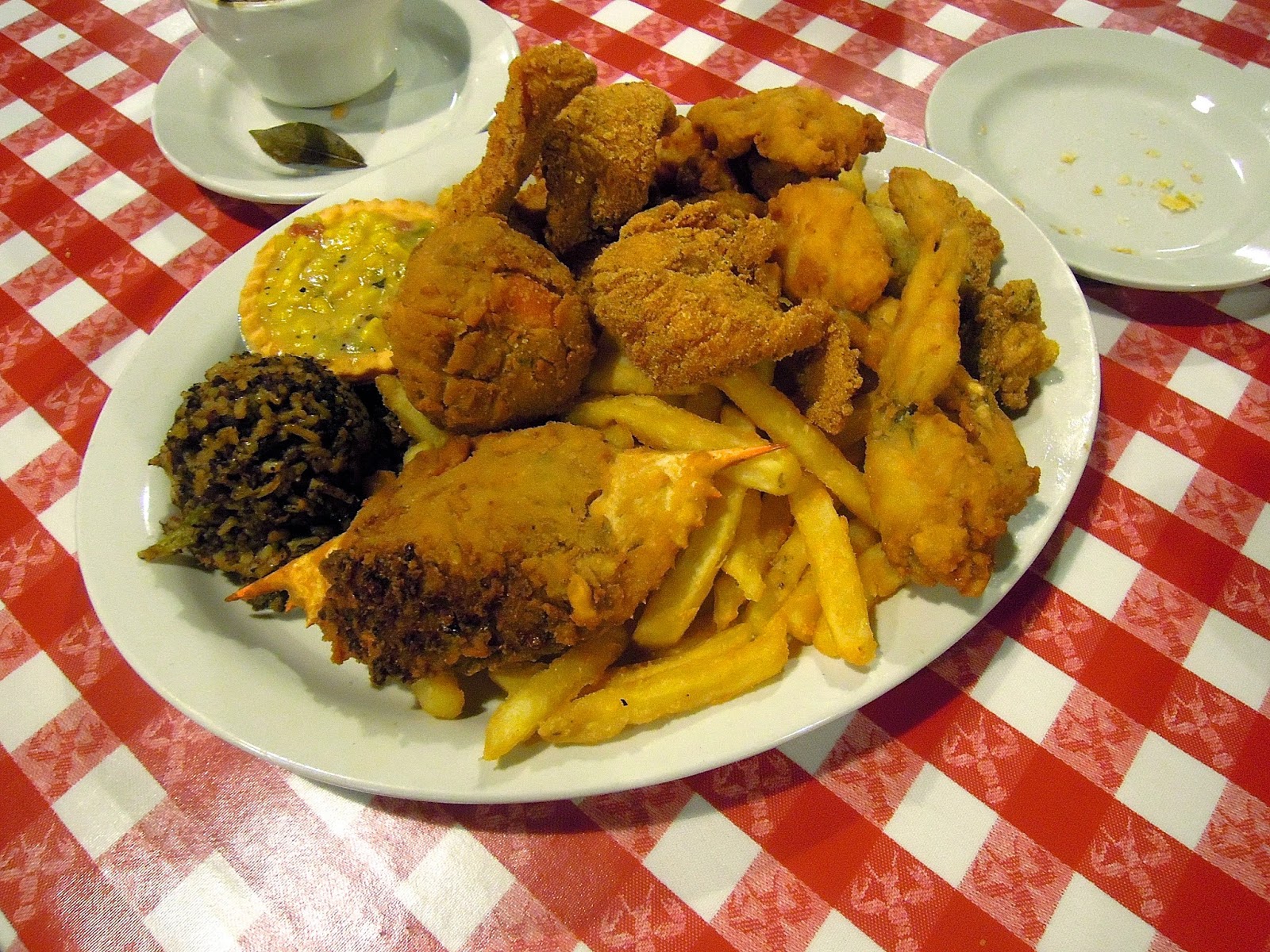
 As we were leaving one of the plantations, a tour guide asked, "Where ya going next?"  When we told him, he said, "You won't find much to eat between here and there unless you stop at the gas station down the road a couple of miles.  They have decent food  and some tables out back where you can sit."  So, after we got in the car and drove to the gas station,  we saw that the guide wasn't kidding.   There were four gas pumps and a bunch of 4X4s filling up.  Inside you could buy guns and other gear for hunting and fishing.  You could also buy lunch.   In a glass case there was an array of fried foods that looked like they were cooked last week.  The unappetizing offerings included sausage, deep fried ribs, deep fried shrimp, and fried chicken steak,  but I didn't see any fried wauhms.  And  the vegetable du jour?   French fries, of course.   Bruce opted for the fried ribs, at the recommendation of the owner.  Karen, Barry and I ate the sausage in a cold roll, but if you added enough mustard, they didn't taste too bad.   Not much ambience, but it was lunch, and as I said in my last post, eating three meals a day was no longer an option.  It was mandatory.


DON'T SEE ANY FRIED WAUHMS


YOU CAN BUY GUNS AND FISHING GEAR, AS WELL AS DOG FOOD 
AND PEOPLE FOOD IN THE LOCAL GAS STATION


When we arrived at the Butler Greenwood Plantation in the pouring rain, we used our car's headlights to find the Chase Cottage for four. We were excited about spending the night at a real plantation, but if it hadn't been so dark and stormy, we might have been more enthusiastic about our lodging.   At seven the next morning, Harold, the plantation peacock, perched himself on our porch railing and sang  Here Comes the Sun in bluesy honkey-tonk way.  


HAROLD


Sunday afternoon Whiskey River Landing,  next to the levee in the Atchafalaya Basin, was jumpin', and we stood in line with all the Cajun and Zydeco fans to pay our five dollar cover.  After stamping my hand, the woman who ran the cash box waved us through and pointing to the left said something like the beer's in there.  While Barry and Bruce went to buy some beer, I used my unabashed tendencies to ask two couples if we could join them at their table, and not surprisingly, they offered us some space.  "I'm Christine," an attractive blonde said, as she introduced herself, and "This is Siggy," a man she later referred to as her friend.  "He's married," she told me, "but we've been just friends for a long time."   Once the band started playing, Christine grabbed my hand and pulled me on to the dance floor, where you could tell zydeco music lived in her bones, but did not live in mine.  Whiskey River Landing is a unique bar and dance hall -- the real deal, where sounds and pictures are better than words.  If you want to see authentic talent, click here  and turn your volume way up high.  After you start the video, wait a few seconds and you'll see some fancy-ass zydeco dancers, who wouldn't give us their names as they were romancing under cover.  And, if you click here, you'll hear some fantastic zydeco music from a band called Slippery Sneakers.  You might even recognize the guy on the accordion.   And isn't that washboard player something else?


WHISKEY RIVER LANDING, BREAUX BRIDGE, LA

THAT'S CHRISTINE IN THE YELLOW JACKET


In some people's minds, taking a Louisiana swamp tour is like going to Sea World -- way too touristy --  but, hey,  that's what we were, so we bought the tickets, found ourselves on an air boat to   explore the bayou and meet famous George.   The moss-laden cypress trees in the swamp reminded me of the bathtub,  a real honest-to-goodness place in the bayou where the movie Beasts of the Southern Wild was filmed.  We didn't see any people, like the little girl Hush Puppy, living out there.  Just murky swamp water and a lot of 'gators.  


THAT'S OUR AIR BOAT ON THE LEFT.  IT WAS CHEAPER THAN THE ONE ON THE RIGHT


THIS IS GEORGE 


Every weekend in Louisiana, there is a festival somewhere, and we hit two in one day.  We saw more crawfish at the Pontchatula Strawberry Festival than we did strawberries,  and my bet is that more people prefer crawfish, although there was a long line at the deep fried strawberries stand.  When I watched them coat the  berries with batter and fry them in a huge vat of hot oil, I opted to eat fresh strawberry shortcake instead.  While eating my shortcake, I noticed a booth nearby where two men were hawking Bibles.  


CHARBROILD OYSTERS, YUM.  PORK RINDS, NOT SO YUM!

WHEN WAS THE LAST TIME YOU SAW SEAMS?


JUST MAKING SURE THERE'S NO TROUBLE  AT THE FESTIVAL


$300 WORTH OF STEAMED CRAWFISH


YOU JUST SUCK ALL THE MEAT AND JUICE OUT OF THOSE
BABIES AND TOSS THE EMPTY SHELLS INTO THAT HOLE


I've been to a blues festival before but never in its birthplace, which is the city of Baton Rouge.  The line up of musicians impressed us, but because of bad weather, the organizers moved the festival from its scheduled outdoor venue into the city's indoor arena.   In our minds the indoor location diminished our experience, although we enjoyed listening to the great sounds of Larry Garner and his impressive group.  It seemed to me that the people of Baton Rouge didn't care whether the music was played inside or out because  blues is the music they were weaned on.  

LARRY GARNER 


                   L'AISSEZ LES BONS TEMPS ROULEZ
                                 (Let the good times roll)


Would I go back to Louisiana again?   The answer is a definite YES.  The Angola Prison Rodeo held at the Louisiana State Penitentiary is coming up in October, and that sure would be something to see.   


Sunday, April 26, 2015

ENTERTAINMENT - NO COVER

There's so much more to the state of Louisiana than famous New Orleans.   What most tourists don't know about is central Louisiana, where they have the same delicious triple by-pass food and foot-stomping music.   Called the land-less-traveled, the small towns and back roads of central Louisiana offer bona fide Cajun and Creole culture in an unpretentious and slower-paced setting.   And add to that the restored centuries-old plantations with their controversial history and the alligator-filled swamp life in the bayous, and you have a destination that is worthy of a visit.   Even the words Cajun and Creole have different definitions here, depending on where you are, who you ask and what color he or she may be.  

The genesis of our trip

Ever since my visit to New Orleans and the start of my infamously- aborted bicycle ride up the Mississippi River (hence my blog's URL),  I have bugged Bruce about going to New Orleans (NOLA). My harping fell on deaf ears until six months ago, when he read an article in an issue of National Geographic Traveler about an area in Louisiana that offered good food, great music and a cultural component as well.  Northwest of NOLA, this area could be best described as Cajun, Creole and cowboy country.  "I'd love to do this trip some time," Bruce said, as he handed me Andrew Nelson's article to read, hoping I would have the same positive reaction he had.  Exploring central Louisiana would take us off the beaten tourist track, and expose us to a different landscape and a unique culture, aspects that both of us crave when we travel.

One of Bruce's many talents is developing an itinerary and bringing it to life, so with that in mind, our good friends Karen & Barry came along, making it even more fun.   Although we were too late for Mardis Gras and too early for Jazz Fest,  New Orleans was enduring another crazy time called spring break.     I could write a separate post about our two days and three nights there, but let's just say that after two days of gustatory debauchery, we headed northwest where we immediately felt the essence of a much quieter life.  With Barry behind the wheel and Bruce as his co-pilot, we stopped often, took lots of pictures, talked to quirky people, and read crazy signs. 


Our menu at Cochon, a popular restaurant in NOLA
  

Is it hot enough for ya?

Did you ever wonder where Tabasco sauce comes from?   Well, we did, so we visited McIlhenny's, the fifth-generation family company that produces more than 700,000 bottles of the famous hot sauce every day when the operation is full up and running.    In my growing up days in the Granite State,  we had our mouths washed out with soap when we swore or talked back to our parents.  Here in Louisiana, kids might get a dose of tabasco instead.   The factory is located on Avery Island, 170 acres of sprawl with its very own bird sanctuary where  thousands of egrets love to hang out.  Many of the live oak trees  have an unusual posture, with moss-ladened branches hugging close to the ground. 


LOUISIANA LIVE OAKS ON AVERY ISLAND

EGRETS NESTING


Cajun Central

The charming college town of Lafayette, 150 miles northwest of NOLA, has many things going for it, and we experienced the top three, beginning with a delicious dinner at Prejeans,  a traditional Cajun restaurant with the best dessert of the week;  tasty bread pudding with white chocolate sauce that Karen and I shared and devoured, with our two spoons rapidly moving toward the center, so that neither of us got more than our share.   One dish at the next table caught our eye -- a Shrimp Festival Platter -- a three course meal of shrimp salad, shrimp gumbo, a platter of grilled, stuffed, fried and blackened shrimp, served with a shrimp butter cream sauce for dipping with a side order of french fries and rice.   Rather than showing offense at my overt reaction, the man being served seemed amused.  "Where y'all from?" he asked.   "You mean you came all the way from San Francisco to eat at Prejeans?"    He shook our hands and introduced us to the group around the table.  "Here's my wife, my two daughters, my nephew, my grandson, and a granddaughter.  My granddaughter here is about to deliver our first grandchild," and then with a big smile he went on to say "she's married."  "My parents didn't have any money, so they put me on an orphan train and a Louisiana family adopted me.  Pleased to meet y'all, and enjoy your time in Lafayette."   

PREJEANS

SHRIMP FESTIVAL PLATTER

NEVER SAW A SIGN LIKE THIS BEFORE


A men's clothing store on Jefferson Street called Right on Fashion sold what some people might call pimp clothes -- every color-of-the-rainbow shoes, some patent leather, some two toned;  chartreuse and bright orange men's suits, and hats for every occasion.  When we saw the flashy display in the window, we knew we had to go in.


PERFECT, BARRY


TO GO WITH BARRY'S ORANGE SUIT


 Lafayette's Blue Moon Saloon has become a premier venue for local music.   Located in a funky house with a hostel upstairs, Blue Moon has live music every night.  We had planned to be there on a Wednesday, the night when local musicians come from near and far to jam.   There is no food.  Only beer.  And no cover.   By the time we arrived, the small main room was already crammed with beer-drinking locals, gathering close to the slightly raised platform where the musicians were tuning up.  I counted 15 of them; some were standing off the edge of the platform, which was not big enough for everyone who wanted to play.  There was no announcement and no introductions.   I saw every string instrument I can think of,  plus a few Cajun extras, like an accordion, a triangle and a washboard.   The music was so infectious that it was impossible to stand still, but there was no way I could move my feet like that.  Cajun dancing is a true art form.  It may be called many things, but I say it's an exuberant two-step, where the footwork is more like a jitterbug than the West Coast swing.   All of the folks we talked to were happy to meet us.  You mean you came all the way from San Francisco to hear music at the Blue Moon Saloon.  


The next day we drove the scenic route to Nachitoches (pronounced Nakatish--don't ask me why), a small town whose claim to fame is the movie Steel Magnolias, which was filmed there.  Our plan was to have a meat pie lunch at Laysones, which is described by restaurant authors Jane and Michael Stern as "One of the 500 things to eat before it's too late."  The drive to Nachitoches wasn't that far, but the guys were having so much fun at the Right on Fashion store in Lafayette that by the time we started driving north, it was already past noon and Laysones closed at 3.    

Even with a map and three GPS devices, finding Laysones had a few problems, as each device gave us different directions.  In the backseat, Karen and I were not much help since we were in hysterics as Barry made one U-turn after another.  "We are going in circles," Karen hooted, as I crossed my legs and prayed to God we'd arrive at Laysones by three.   Not only was I hungry for a meat pie, but I needed a bathroom urgently, and the last thing Barry needed to hear was: Can we find a bathroom?  At 2:45 we walked into Laysones, passing framed photos of visiting celebrities, and asked "Are we too late?"    "No problem," said Helen, our excellent server, who Barry said looked just like.........   "You look like Liza Minnelli," Barry exclaimed, and immediately Helen was in Barry's pocket.  "You mean you came all the way from San Francisco to eat our meat pies?"  We didn't deny this, despite our indecisions about what to eat.   Helen patiently crossed out several orders when one dish sounded better than the other. "Yes, we'd all like a meat pie, but will that be enough? "  We were starved.  After all, we hadn't eaten since breakfast and the clock said 3 pm.   Three meals a day was de rigueur.   "Maybe we should order a meat pie, a crawfish pie, and a bowl of gumbo just to be sure." And a side order of fries, which seemed to be the only vegetable so far in this part of the state.    For those who don't know, a Louisiana meat pie is like an empanada, except it's deep fried.  The operative word here is deep fried.  Need I say more?


Bruce and Karen checking out Laysone's menu
    
Delish!


Our B&B in Nachitoches


We made another friend in Nachitoches besides Helen.   David was sitting at the local bar when we walked in.  I don't know whether the khaki pants that Bruce and Barry were wearing tipped him off, but David definitely spotted us as tourists and wanted to become instant friends.  When he heard we were from California, he told us about how he fell in love with redwood trees when he visited Muir Woods.    He also mentioned a serious brain injury he incurred from a bicycle accident, and after a few drinks together, Barry and I wrote down his Natchitoches address and promised to send him a California redwood tree.   Have you done this yet, Barry?


Stay tuned.  The adventure continues................


Sunday, April 5, 2015

CLOSER TO THE BONE, THE SWEETER IS THE MEAT

Some of our California friends wondered what possessed us to take a trip to Texas. They might have asked the same question if we had said we were going to Arkansas or West Virginia because these U.S. states are not our usual destinations. Most of the time we take long overseas flights to experience unusual sights and exotic cultures, but this time we could accomplish the same thing by just going to Texas.

We had been advised that the 20 minute drive from Austin out to Lockhart for barbecue at Kreuz's was worth it, so we went. Now I know why my friend laughed when I asked if we needed reservations. From the outside, Kreuz's reminded me of a big-old-fashioned dance hall, like the kind we had in New Hampshire in the 50s and 60s, when I was growing up. It was 7 pm when we arrived, and because there were a series of large empty rooms, none of which looked much like a restaurant, we weren't sure where to go or how to order. Eventually we found ourselves in the smoke room where there was a large chalk board listing the meats sold at prices between $14 and $17 per pound.


"We're out of everything except pork chops and sausage, and maybe a couple of beef ribs," said the tired-looking woman standing next to the scales. "We're out of beef and chicken and brisket. What a crazy day." Granted it was Good Friday and the start of a busy weekend, but there were only a few trucks in the parking lot (like big hair, big trucks are ubiquitous in Texas) and the cavernous dining room looked pretty empty.


"I'll have a pork chop and a sausage, " I said. "Me too," said Bruce, and a couple of pieces were thrown on to several thick sheets of brownish pink butcher paper, wrapped loosely, and tossed our way. "You can git drinks and sides through those double doors over there," the tired lady said, as she weighed the meat, rang up twenty two bucks, and pointed in the direction of the doors. Once on the other side, the woman selling sides and drinks said they were out of potato salad, mac and cheese, and coleslaw but still had red cabbage and pinto beans. "Ok, two beans and two cabbages and a couple of beers," we replied, wondering why their supply was so limited at 7 pm. "Maybe people eat early in Texas," I said, as I looked around the nearly empty fluorescent-lit dining hall, and saw only a few families eating pork chops and sausages too. Oh and I mustn't forget. There were no plates. You ate off the butcher paper and there were no forks. Only plastic knives and spoons, which meant we ate Tom Jones style, although the spoons came in handy for the sides. In addition, the large role of paper towels was a perfect substitute for napkins, but I could have used some dental floss too.


The adventure continues............


Posted using BlogPress from my iPad

Wednesday, April 1, 2015

TEN DAYS, TEN POUNDS

There are certain words, names and images that come up when I think of the State of Texas.  Thinking positively, there was Molly Ivins, the great newspaper columnist and political commentator, Ann Richards, an outspoken feminist and the 45th Governor of Texas, the movie Giant, an epic portrayal of a powerful ranching family starring Rock Hudson and Elizabeth Taylor,  Big Bend National Park,  my first birding experience with Lynne Aldrich when she lived in Houston, and the Tex-Mex town of El Paso, where my mother-in-law used to live. 


Big Bend National Park (with thanks to National Geographic for the photo)


 Unfortunately most of my negative thoughts about Texas are politically based:  George Bush, Rick Perry, Ted Cruz, Ron Paul, legislation to ban gay marriage, and a hardline stance on immigration, gun control and abortion.  Just typing these words gives me the heebie jeebies.

And yet, when I get on a plane tomorrow, I'll be heading east and landing in Texas.  We are not staying long.  Just time enough for a quick breakfast in the state capitol, see and photograph the famous Blue Bonnet wild flowers made famous by Lady Bird Johnson, give a big hug to Lea, an Australian friend, who is riding her bicycle across America and just coincidentally will be in Fredericksburg, Texas the same night we will, and to have dinner in San Antonio with a wonderful friend I went to high school with in Maine.  


Blue Bonnets of Texas


After Texas, we'll fly to the Big Easy,  the famous city of New Orleans, Louisiana where, along with good friends, we will see as many sights as we can cram into two days, eat as much shrimp, oysters, crawfish Ã©touffée, jambalaya and beignets as our stomachs will hold, listen to great music like lil Red and Big Bad at the Balcony Music Hall, Marcia Ball banging away at those keys, and checking out the NO Music Exchange on Magazine Street.  

And after NOLA, we'll drive north along the Cane River to a city whose named is spelled Nachitoches but pronounced Nakateesh, where they are known for their amazing southern hospitality and their empanada-like meat pies.  We'll find time to tour the famous Tabasco factory on Avery Island, attend the annual Strawberry Festival in Ponchatoula, and a blues festival in Baton Rouge. 


I'm telling you this now, so you can keep an eye out for some photos and descriptions of what's to come.

Stay tuned.  The adventure continues....................

Friday, March 13, 2015

HIKING IN THE PINNACLES NATIONAL PARK

I have traveled all over the world, but why is it that I've never been to one of nature's greatest gifts that sits in my own backyard?  

This is something one of my Facebook friends asked when I posted a photo of Bruce and me hiking at the Pinnacles National Park. Although the newly-designated National Park is only a two hour drive from our house, neither of us had ever been there, and I've lived in California for close to fifty years.


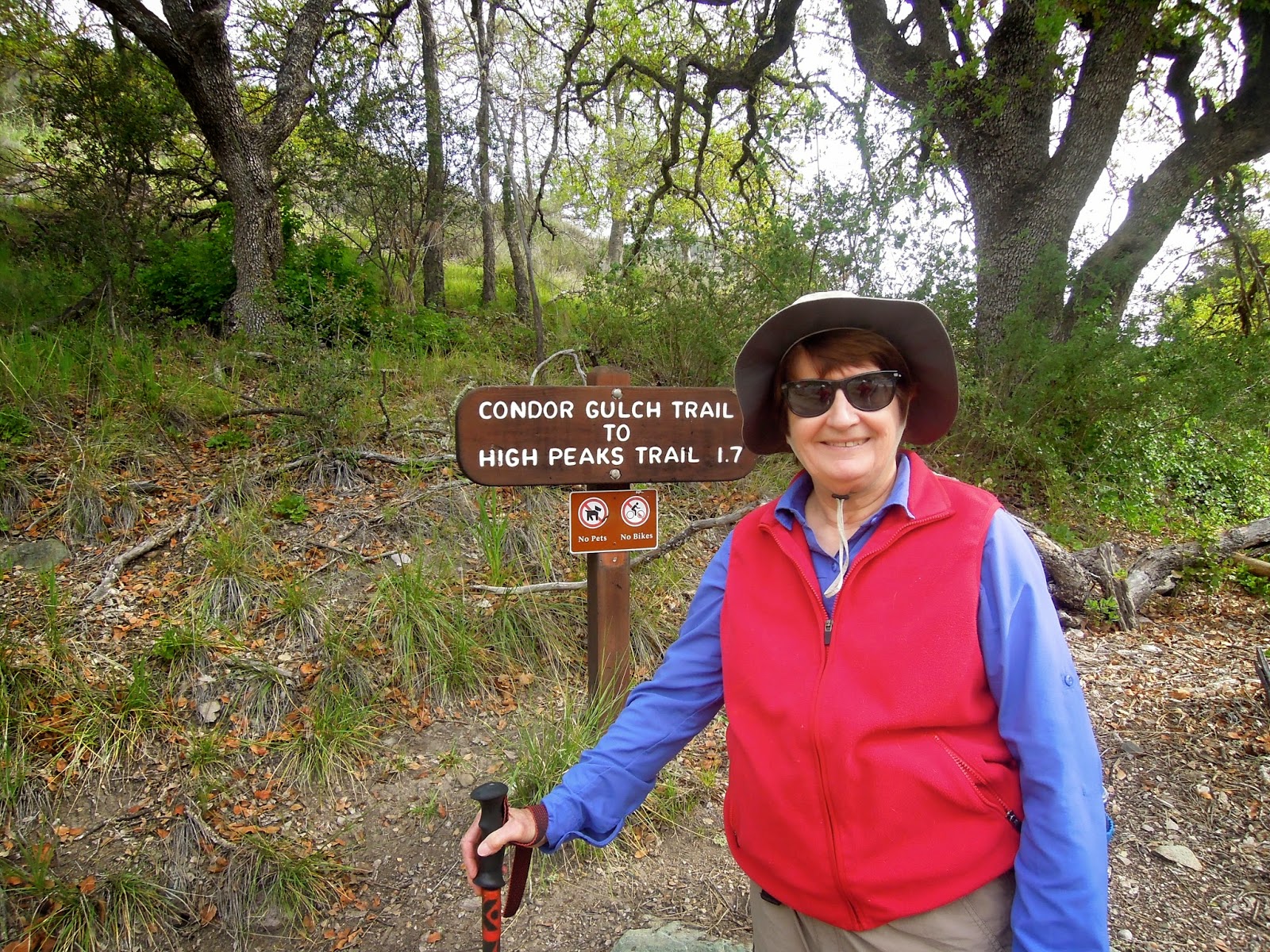
Located just south of Hollister and east of Soledad, the Pinnacles National Park consists of eroded leftovers of an extinct volcano that over thousands of years moved almost 150 miles from where it was originally sited on the San Andreas Fault to where it now sits near  the Salinas Valley.  The park can be accessed from both the East side and the West side, but the only way you can travel within the park itself is on foot, hiking on beautiful trails through a series of large boulders and huge colorful rock formations that in some ways reminds you of our country's beautiful Southwest.  As you will see in the pictures included with this post, some of the trails are scary, precariously sited on the steep edges of rock formations, especially if you hike the famous High Peaks Trail.  


Ever since last summer when hiking became a weekly activity for me, I have wanted to organize a group trip to the Pinnacles, but choosing the right time of year to go is critical.  Spring is definitely the best time, if you want to see an abundance of wild flowers.  The air is cool and perfect for hiking.  Also, if you are fortunate enough to visit during a rainy winter season, when we are not in a drought like we are now, you would witness multiple waterfalls cascading down the beautiful red and black volcanic rock.   However, summer months can be brutal as temperatures often climb into the high 90s, and since there is little shade within the park, hiking can be quite uncomfortable and even dangerous. 


photo by Bob Yee


Finally, last week Bruce and I plus a group of six friends arrived at the Pinnacles for a hike led by Lynette, a veteran Pinnacles hiker, whom I was fortunate to meet last fall at a travel presentation.   When she talked about her extensive hiking experience,  she also mentioned her love for the Pinnacles.  I told her of my interest in getting some friends together to hike there, so she generously offered to be our leader and take us through a maze of trails, so that we could have the best hiking experience that the Pinnacles has to offer.   We also hoped to see the adult and juvenile condors that live within the park, but since early morning and sunset are the best times for viewing, we weren't sure we'd be so lucky to see them on this trip.  


Leslie

Bob and Shannon

Connie


Photo by Bob Yee


The weather on March 10th was ideal for hiking, especially since our very dry winter and now dry spring has also been unseasonable warm.   Luckily for us the sky was overcast, and the temperatures ranged in the low 70s.   After discussing our hiking options, we all agreed to take on the challenge of the High Peaks Trail, knowing that if we couldn't climb those rocks this year, we probably would never do it.   I had watched a YouTube video of some folks climbing the High Peaks Trail, and it looked pretty scary, especially for someone, like me, who has a fear of heights.  On the other hand, I knew that it was just mind over matter, and that as long as I held on tight to the iron railing bolted into the rock for protection, and if I walked slowly and carefully, I'd be o.k.   

Around 10:30 a.m.,  we began our ascent on a dirt but slightly rocky trail that was not as difficult as I expected, especially since Lyn warned us that the first half mile was pretty steep.   Although we were just a little ways out of the valley, the views looking out were beautiful.  I thought this might be a trip I'd blog about, so I took out my small point and shoot camera and began snapping away.  After taking about 20 nondescript photos, I was stunned to see the message out of memory show up on my camera screen.  Since I don't use this camera that often, I charged the battery the night before and even noticed a message that said no images in camera.  What the hell? I thought.  I looked inside my camera and saw that the chip slot was empty.  I couldn't believe I'd been so dumb, beating myself up as I saw one prize-winning photo opportunity after another, but couldn't take a picture. It seems that the twenty or so photos, most of them pretty bad, were captured on my camera's internal memory, and the internal memory doesn't have much space.  And stupidly, it didn't occur to me to erase the twenty lousy pictures, and capture some better scenery along the way.  Fortunately, other people in our group kindly agreed to let me use their photos in this blog. Thank you Bob Yee and Bob Ende. Anyway, enough of this camera crap talk and back to the hike.  


Photo by Bob Yee 


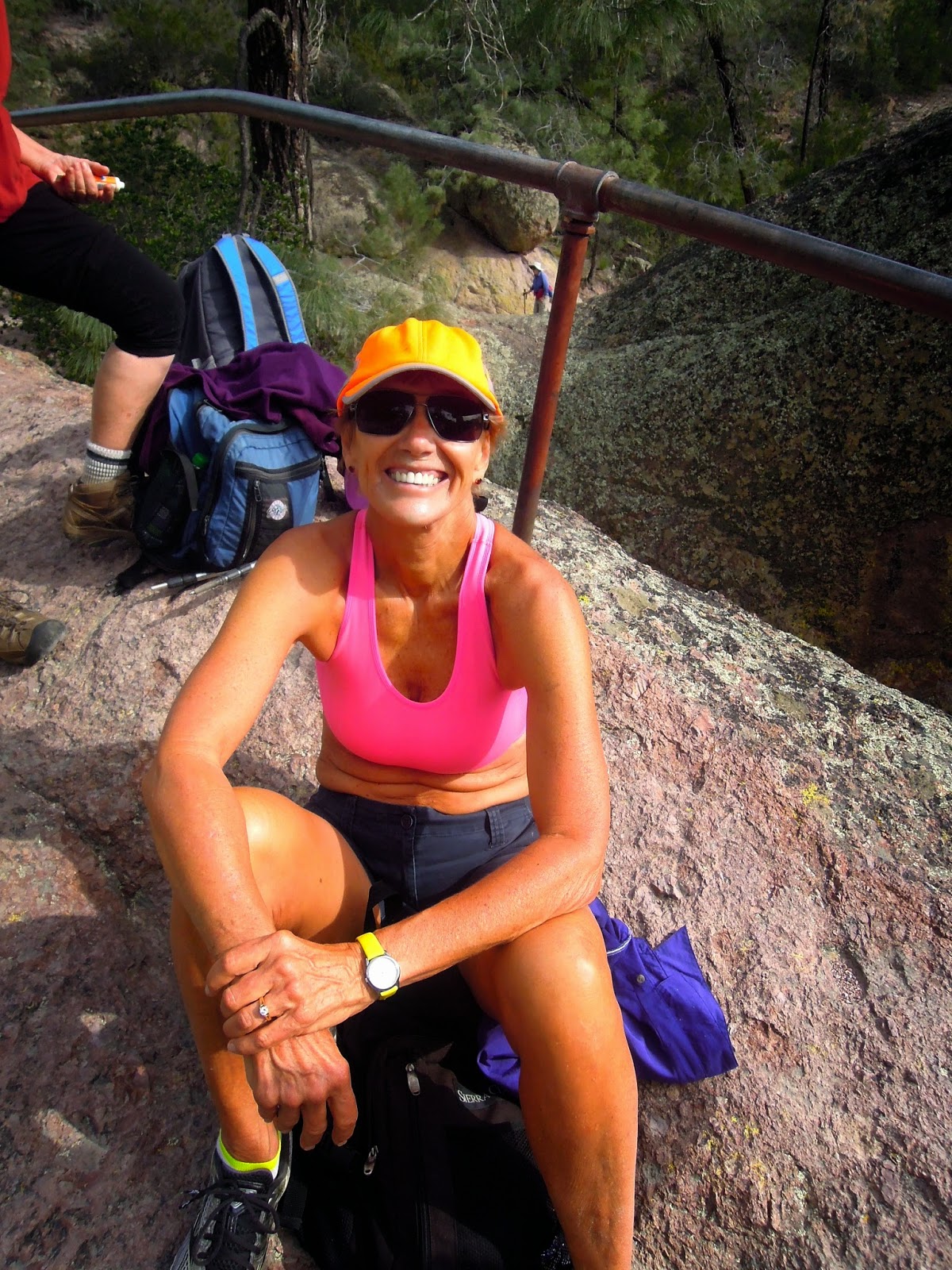
After walking uphill for about an hour, we came to the scariest section of the High Peaks Trail -- the portion I'd been really dreading -- climbing up the sides of pinnacles and boulders, either on medium-sized rock steps that had been placed one after the other on a steep trail of smaller rocks and then more steps that had been carved deep into the sides of the rock where we could take one small step at a time.  With each high step and each deep breath, I hung on to the iron railing that was securely bolted into the solid rock and looked straight down at my feet as I carefully ascended one step at a time.  I wanted to make sure that each foot was firmly planted on a rock step or placed squarely in the dugout step before continuing on.  


All climbing photos by Bob Ende


It wasn't as scary as I thought it might be, but it did remind me of the first time I discovered my fear of heights.  It was a few years back when I found myself standing precariously on a narrow ledge while hiking in Zion National Park.   I panicked and froze until I was brave enough to inch my way to safety with Bruce inching right behind me.  He wasn't any braver than I was, which made me happy that I had someone to share my fears with.   I was also reminded of the time I was driving solo in an ATV (all terrain vehicle) in Namibia, Africa at the precipice of one of the steepest sand dunes I'd ever seen and the guide telling me that there was only one way to get back to the camp and that was for me to take that mother of an ATV down the steep side of that soft sand dune.  When our guide saw the tears on my face and heard that god-awful wail, he knew that the only thing he could do was hold on to the back of my ATV with his hands and dig his feet deep into the sand to  slow my steep descent down that bleep bleep sand dune.    Compared to the fear-of-height experiences in Zion NP and Africa, climbing the High Peaks Trail at the Pinnacles was a piece of cake.


Once we reached the top, similar rock steps took us down the other side.  Again I held on to the iron railing until I reached safer ground, but the descent was pretty easy compared to hiking up.      Once we made it to a large ledge that offered safety and a fabulous view, we took out our home-made sandwiches from our packs and enjoyed our well-deserved lunch.   I'm sure the others had the same glorious feeling of accomplishment that I did, not to mention a sigh of relief -- the same sigh of relief I felt when I reached the bottoms of the canyon at Zion and the sand dune in Namibia.


image1.JPG
Photo by Bob Ende


After descending the precarious high peaks, the trail led us through tunnels of boulders and around green and red lichen covered rocks. While some hikers brought poles to assist them with steep pitches, I left mine at home thinking that a stick would only create problems for my already fragile shoulders.  That was a good decision because when Lyn gave me her second stick thinking it might be helpful, I realized it was more of a hassle than a benefit, especially when I needed two hands to keep myself steady. 

None of us knew what to expect in terms of the wildflowers.  We wondered whether our three years of drought might impact the abundance or perhaps we were too early or too late to get the flower show that others have raved about?  There were some beautiful flowers, but not a huge amount, but I did enjoy seeing a new flower called a shooting star which I had never seen before.  We came across a reservoir filled with water and walked through narrow rock tunnels and sulphur-smelling caves.  We also saw some young climbers hanging on the sides of steep pitches with their ropes and pitons.  We wished them well as we headed back down to the parking lot for a total of 7.5 miles of hiking.  We weren't able to assess our elevation gain, but my Fitbit said we'd climbed 181 floors.