Wednesday, May 28, 2014

EXPLORING MY ROOTS

What a weird feeling to be standing on the same stone bridge as the one in the photograph that hung on the wall in my parents' house all the years I was growing up.   When I was a little kid,  my mother would point to that picture and tell me how the ancient bridge in her Greek-Vlach village was one of the few landmarks that survived the destruction during a Balkan war.   And here I was, many years later, looking out at the same beautiful view that my mother saw when she crossed that bridge as a child.   


THE BRIDGE IN MY MOTHER'S VILLAGE


I had a similar reaction when I saw the church in Samarina, the village where my father was born.    It wasn't just the church that brought me to tears.  It was seeing the lone pine tree growing out from the church's apse, just the way Daddy said it did.  Over the years I'd forgotten about that tree, but now, with my own eyes, I could see the tree looking strong and healthy which made me feel really homesick for my Dad. 


IN SAMARINA THE PINE TREE IS STILL GROWING OUT OF THE APSE FROM 
THE VILLAGE CHURCH IN 2008  


NOTE THE CHURCH AND THE SIZE OF THE PINE TREE.  THIS PHOTO WAS TAKEN FROM A BOOK PUBLISHED IN 1914 ENTITLED  THE
NOMADS OF THE BALKANS:  AN ACCOUNT OF LIFE AND CUSTOMS AMONG THE
VLACHS OF NORTHERN PINDUS


In 2008, four of us traveled together on what I like to call "exploring Pam's roots trip."  There was my niece, Susan, her daughter Maddy, and Bruce and I.   With the exception of Bruce whose Jewish roots come from Eastern Europe, we were three generations of Greek-American Vlach women, visiting the birth place of our parents, grandparents and great grandparents in the remote mountain Vlach villages in Greece

 We started our trip in Ioannina, a university town that sits on the edge of a beautiful lake in northwestern Greece, in the Epirus region to be exact. Ioannina is the home of an extended family of Brajitulis cousins, once, twice and three times removed.   Only a few of them spoke English, but all of them were eager to see us.  I'm not sure we knew what to expect; we certainly didn't imagine they would roll out the red carpet, but they did.  In each of the three Brajitulis households we visited, we were greeted with shouts of joy,  hugs and kisses, and more delicious food than we could possibly consume.  From the stories (and jokes) told to us in Greek but translated into English, we learned how my parents -- Nick and Lucia -- were adored, and how much their visits back to their homeland meant to the families who stayed behind.   My niece Susan and her daughter Maddy brought a large manila envelope of historical photographs they found in my mother's belongings after she died.   I brought the family stories, and Bruce brought the video camera.    


A FEW MEMBERS THE BRAJITULIS FAMILY WITH PAM, SUSAN & MADDY


My mother used to say, Pammywhen you go to Greece, you will have to go in August because up there in the mountains, the snow doesn't melt until June, and the roads don't open until July.   Since August can be a very hot month, I'm sure I added  "heat" to my long list of reasons why I didn't want to go to Greece.  

Well, my roots trip was in May, and maybe it was climate change, I don't know, but the snow was long gone,  and the roads were perfectly clear.   And yet, on the day we drove to my father's village of Samarina,  travel was a nightmare, due to the dense fog we encountered as we drove up to this mountain town, known as the highest village in all of Greece.   At one point, the visibility was so bad, Susan stepped out of the car to see if we were still driving on the main road.  Telling this story now sounds amusing, but at the time it was a little scary because we weren't on a road at all, but instead we were driving in a parking lot next to a ski lift. After finding ourselves back on a paved road, we stopped to ask for directions.   When we heard the musical clanging of bells and spotted the herd of goats, we asked the shepherd in English how we should go, but all he heard was blah, blah, blah, so he was no help at all.  And as far as the bartender in Smixie was concerned, he too only heard blah, blah, blah.  
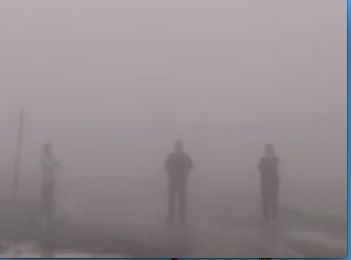

SUSAN, MADDY AND PAMMY CALLING OUT "WHERE ARE WE? "


About that time I noticed there were reception bars showing on my cell phone, so I called the number of the hotel in Samarina where we were staying  and hoped someone would understand me.   The phone rang a couple of times and suddenly I heard a man's voice shouting, "Pamela, Pamela.  Is that you?"  "Yes, it's me," I shouted back, wondering how he knew my name or how he knew the call was from me.  Again, he shouted, "Pamela, is that you?  It's Likos."   Then I remembered that the Greek word for Yes is Neh, which, of course, sounds like the English word for No.   In desperation and hoping I would be understood, I shouted back to Likos "Yes, No, Yes. I mean Neh, Neh, Neh."  Suddenly the line went dead.  "Oh, damn," I said to the others in the car, "I lost him."   A minute later my cell phone rang, and a woman's soft voice speaking English with only a slight accent said, "Pamela, is that you?"  "Neh, Neh," I  responded quickly without thinking.  "I mean "Yes, Yes. I'm Pamela."  She said her name was Stella, and  she was Likos's daughter.   She asked where we were, and although I wasn't entirely sure, I told her we were on the road outside of Smixie.  "Stay where you are," she said.  "My father is coming to find you.  Look for a red jeep."  And then I heard a click.  She hung up.  So, we turned off the engine of our rental car and crossed our fingers waiting for the red jeep.  Thirty minutes later out from the dense fog, the red jeep appeared.  A man with a sweet-looking face and a big grin rolled down the window and said,   "Pamela, is that you?  It's Likos."   "Neh, Neh," I shouted back with relief.   He made a U-turn in the road and signaled that we should follow him.

Finally we arrived at the comfortable hotel Likos owned in the Vlach village of Samarina, but we were starving, since the box of baklava we'd eaten for breakfast was long gone.  I called Likos's daughter on my cell phone and told her how happy we were to be in her dad's hotel, but now we were hungry and had no idea where to find food, since we thought we were on the outskirts of town.   "I'll call you back,"  she said.   A few minutes later my cell phone rang and Stella said, "My dad will take you to eat in a restaurant in town."  "Oh, that's so nice," I said.  "We'd really appreciate it."  Hoping she could come along and serve as our translator, I added, "Would you be able to join us?"   She laughed and thanked me for the invitation.  "I'm in a boarding school about three hours away, " she said, "so it's not possible,  but you will like the food."  That's when I realized, with amusement, that the translator for our communication with Likos was nowhere near the location where the conversation was taking place.

All four of us piled into Likos's jeep, and in the heavy fog he drove into town, parked the jeep, and escorted us into a rustic taverna.   The unassuming place was bustling with activity and very noisy until the five of us stepped through the front door.  That's when everyone went silent.  Even the server stopped to see what was happening, and they all watched as Likos led the four of us to a table nearby,  sat us down and handed us menus.  Soon conversations around us began to resume,  but it was clear people were very curious who we were and wondering why Likos was escorting us into the restaurant.   We nodded appreciatively,  as he  pointed to some items on the menu he thought we might like. As he strutted into the kitchen, Likos puffed himself up like a proud peacock, all the while grinning and looking back at us and then over to the other patrons as if to say to them these people are mine.  That's when we figured out that Likos owned the restaurant! 


The red carpet was rolled out for us again.  Likos emerged from the kitchen carrying a platter of grilled sausages, lamb chops, and fried potatoes slathered with melted goat cheese.   And, of course, there was the ubiquitous Greek salad and plenty of dense bread, the white kind with a thick crust, good for soaking up whatever juices remained on our plates.   Likos sat down and ate with us at the table, seemingly content that everyone was happily scarfing down his delicious food.    


SUSAN, MADDY & BRUCE IN LIKOS'S RESTAURANT


After Likos cleared the plates we showed him the letter of introduction that my cousin had written in Greek, saying we were descendants of the Pispirikos family and explaining why we were in Samarina.  I should have assumed he already knew, since my cousin in Ioannina made the hotel reservation.  Susan opened the thick manila envelope filled with black and white photos of my parents when they were young and other ones they took when they returned to Samarina on visits in the '50s, '60s and '70s.   Likos became excited and very animated when he recognized my parents and loved seeing the old pictures of the village and the local people who were still around.    


SUSAN AND I LOOKING AT OLD FAMILY PHOTOS WITH LIKOS


ON THE LEFT, MY DAD AS A YOUNG MAN.  I THINK THE OTHER MAN MAY BE HIS BROTHER


Something special happened to me that evening in the restaurant, although I can't put my finger on exactly what it was.   It felt almost spiritual, maybe even akin to magic.   As I sat there listening and watching Likos look at the family photos and interacting with Susan, Maddy and Bruce, I had a sense of connecting.    Maybe it was some other strong emotion, like really missing my parents.  I don't know, but it felt deeper.  Maybe I was finally feeling what it means to be a Vlach.  


Stay tuned....................

Sunday, May 18, 2014

SELF ACCEPTANCE

I'm wondering if the reason I'm so fascinated by tribal cultures is because I'm from a tribal culture myself.   This is true.  Growing up, my parents never described our family as an ethic minority group or called us members of a tribe.  But we were.  The ah-ha moment hit me not that long ago when someone asked about my heritage and family background.   We had just returned from visiting the ethnic minority groups in China at the time, so the notion that our family might be called tribal began to surface in my mind. 

Both Mom and Dad, who were born in Greece, were Vlachs.   They called themselves Greek, but they were Vlachs first.  My mother was born in Biasa, an isolated village located in the Pindus Mountains in northwestern Greece.  For centuries, the residents lived a peaceful but nomadic life, herding their sheep and growing olives, and then trading wool and olive oil for coffee and tobacco with merchants who traveled throughout the region.  Not in touch with what was going on in rest of the country,  the Vlachs developed their own customs and language, and kept to themselves in a tribal way.


VLACH WOMAN SPINNING WOOL


My father was a Vlach as well, born in a village called Samarina, just over the mountain from Biasa, where my mother lived.  In those days there were no roads that crossed those rugged mountains,  so villages remained isolated from one another.  Like the people who lived in Biasa, the Vlach sheepherders in Samarina preferred a simple nomadic life.  


SHEEP GRAZING IN THE PINDUS MOUNTAINS


Who are the Vlachs?

Anthropologists, linguists, and historians are still studying the origin of the Vlachs, but many believe we are descendants of Roman people, who fled in the fourth century AD, when the Roman Empire was collapsing.  Hordes of people were looking to escape from the Huns and finding a place of their own.  Eventually, most of them settled in the region that now includes Greece, Albania, Macedonia, and Bulgaria.  The Vlach language, which my parents also spoke, is more like Romanian than modern Greek.  


VLACH MEN IN THEIR NATIVE COSTUME


Only a mountain separated my parents from each other, but they didn't meet until they were here in the United States.    They both had interesting stories to tell.   In an effort to find safety during the first Balkan war in the early 1900s, my maternal grandfather left Biasa and his family, and sought passage to the United States. After several years of trying to figure out where to settle in this strange new land,  he finally sent for his family because he found a place that reminded him of Greece.  That place was called St. Johnsbury, Vermont.   During the years my grandfather was away, war spread throughout the Pindus mountains,  and my mother's village of Biasa was pillaged by soldiers, and her home was burned to the ground.   Around the same time, my father, not having much of a family life in Samarina, came to America alone.   As a 13-year-old runaway, he had only a New York address of a family member written on a small scrap of paper and tucked deep inside his jacket pocket. 

   
 ORIGINAL IMMIGRATION FORM FOR MY MOTHER - 1920
SHIP MANIFEST WITH THE NAME OF MY MOTHER - 1920


A DRAWING OF THE SHIP THAT BROUGHT MY MOTHER TO THE UNITED STATES


My Vlach parents

My parents told me early in life that I was a Vlach, something I should be proud of, but as a little kid, I didn't know what being a Vlach meant.  I couldn't comprehend what being a Greek meant.   I knew my parents were a little different from my friends' parents, but they weren't eccentric or old fashioned like some of the Greek people my parents knew.  Instead they were hard working and forward thinking, always wondering what they could do to get ahead and educate their children.     When they told stories about what their childhood in Greece was like,  I thought they had lived on a different planet.   To me, Greece was just that.  Another planet. 


MOM, DAD AND ME IN THE 1970S


My parents greeted other Vlachs they met like kin, whether they were from Samarina, Biasa or somewhere else.   I can swear on a stack of bibles that my father knew every Vlach within a 200 mile radius of our town.  That's just the way he was.  Every summer we went to a Greek picnic in the southern part of our state, where we line danced to bouzouki music and ate roast lamb that had been cooking over an open fire for hours.  My mother, not known for her Greek cooking, brought several large pans of spanokopita that she made from scratch.    My father would oversee  the skewers of kokoretsi blistering on a slowly turning spit.  Greek Vlachs from all over New Hampshire and Massachusetts would come to renew friendships, tell funny stories, and reminisce about the old country.   


KOKORETSI (LAMB INTESTINES)


Accepting my heritage

I don't know why, as a youngster, I renounced my Greek and Vlach heritage, but I did.   Learning a different language seemed like a waste of time since we were the only Greeks in our small town.   As a teenager, I rejected the idea of baptism in the Orthodox church because I knew it was a full body dunk.  I never dated any Greek boys since the last thing I wanted to do was marry one.  And yes, as an adult, I liked to cook Greek food, but I also enjoyed cooking Italian, Thai, and Indian.  Not surprisingly, I never had any interest in going to Greece.

In 2007, Bruce and I took a trip to Turkey.   Maybe it was the way the people smiled at me, or how they exuded warmth when they said hello,  but many of the Turks I encountered reminded me of my Greek parents.   The two cultures are so similar in their customs, their food, and their relics that my childhood memories came flooding back.   I learned more about the conflicts between Turkey and Greece following the first World War.  In order to staunch the bloodshed, the Greek and Turkish governments signed a population-exchange agreement.  According to the terms of the deal, Greek Orthodox residents of Turkey had to relocate to Greece, while Muslim residents of Greece had to move to Turkey.   As a result of this, entire Greek villages in Turkey became ghost towns, and after seeing one or two of these on this trip,  I realized that I was ready, and it was time for me to visit Greece.  


GREEK GHOST TOWN IN TURKEY


In 2008 we planned a trip and invited my niece, Susan, and her twelve-year-old daughter, Maddy.  Fortunately for us, Susan is the genealogist in our family, collecting stories, old photographs, and family trees.   Using social media she has even reconnected us with Vlach people from our family's past.   Putting the trip together involved conversations with my aunt and her family in Rhode Island, who put us in touch with English-speaking relatives in Greece.  After  research and email communications back and forth, we settled on an itinerary that took us, three generations of Greek Vlachs, to meet our relatives for the first time, and explore the remote Vlach villages of Samarina and Biasa, where my parents were born. 

Stay tuned..............


Wednesday, May 7, 2014

ON BECOMING A COLLECTOR - PART 2: THE MAD HATTER


Collecting hats came next.  In northern Laos where we were trekking from one Akha tribal village to another, we were impressed with the unusual ceremonial hats worn by the women who greeted us.  "I want one of those," I said to Bruce, after my eyes locked on a beautiful beaded hat decorated with heavy silver coins. 

   
MY FIRST GLIMPSE OF THE AKHA CEREMONIAL HAT


HER LIPS AND TEETH ARE STAINED RED FROM CHEWING BETEL NUT


When we asked our local guide what it would take to acquire one,  he shook his head and said, "These hats aren't for sale."  We didn't want to believe him, but unfortunately, he was right.  The Akha hats weren't for sale.  At least not the ceremonial ones I coveted because they were family heirlooms and handed down from generation to generation.   "You might find some beaded hats when we visit the market tomorrow," he told us.   We had already seen the hats in the market, but they were like an embroidered beanie and not a heavy royal crown.   A few weeks after we returned from Laos, we saw a similar Akha hat for sale at the San Francisco Tribal and Textile Arts Show, so we bought it.   I like to think we were meant to have that hat.


FINDING THIS HAT AT THE TRIBAL SHOW MADE ME VERY  HAPPY


While hiking in the Simien Mountains of Northern Ethiopia, we bought two hats right off the heads of a couple of young shepherds who were tending their goats.  We didn't particularly love the hats, but the kids wanted to trade something with us, and since we didn't have anything to trade, we took out a few birr and bought their woolen hats.  The problem was these hats smelled so terrible that we had to keep them separated from our travel clothes for the rest of our trip.   Honestly, I'm not quite sure how we managed it, except that after the Simien Mountains, we traveled to the remote tribal region of South Omo where everything smelled like goats, so I guess we got used to it.  (N.B.  I don't think we really got used to it because when we returned home, I had to air the hats outside for a couple of months before I could display them.  I swear when I walk by the shelf, I still smell goat!)


SHEPHERDS HAT FROM ETHIOPIA


In Tanzania we bought a beaded crown worn by the Yoruba tribe in Nigeria, a country we weren't planning to go to.   In Arusha, Tanzania, there is this incredible place called the Cultural Heritage Center, which definitely deserves to be called the motherlode of tribal art.  There are three, maybe four buildings with two levels each chock full of fabulous "stuff," like masks, wooden and stone carvings, jewelry, shields, fetishes, statues, pottery, wooden alters, doors, and windows, swords, paintings, weavings, and other handicrafts.  This is the place where I can honestly say my husband lost his mind.   


AURUSHA CULTURAL CENTER

THE MOTHERLODE OF TRIBAL ART


YORUBA BEADED CROWN FROM NIGERIA


There were a lot of different hats for sale in the Masai village we visited in Tanzania, but this one was small enough to transport home, and that is always a factor to consider.


MASAI HAT, TANZANIA


The hat below is from Turkmenistan, but we bought it in an antique store in Bangkok on our way to Bhutan.  The shop owner was also willing to sell us the wrought iron display stand and even shorten it a little to meet our shelf dimension at home.  The only problem was that there wasn't enough time for him to do the work before we left for Bhutan early the next morning.    For a few extra dollars, the man agreed to alter the stand and then, along with the hat, send a well wrapped package by taxi across the city to the airport hotel, where we would staying two weeks later when we transferred through Bangkok on our way home.   


A HAT FROM TURKMENISTAN


We saw this crazy hat when we were in Borneo, Malaysia.  Someone told us it was a chief's hat, but we never saw any chiefs so that label can't be authenticated.  We bought it anyway.   It was too fun to pass up.    


CHIEFS HAT FROM BORNEO


This decorative child's birthday hat jumped out at us while we were walking through a market in a Dong village in Guizhou Province, China. Although the owner of the shop didn't speak any English, he was willing to pose for the photo.  Both Bruce and I thought he looked like Genghis Khan.  


GENGHIS AND PAMELA KHAN


We have a few smaller hats that we acquired in Egypt, Bhutan, Laos, and Oman.   Surprisingly, finding an Omani kumar that was hand-stitched rather than stitched by machine was a challenge.


THESE OMANI MEN ARE WEARING THE TRADITIONAL KUMAR


In Burma,  I told Bruce,  "No more hats.  "We have too many already."  Mild-mannered Bruce didn't disagree, but he didn't agree either.  Then we saw this! 


NAGA TRIBAL HAT


With a grin on his face, he looked at me and said, "I think we can get it for $60. " What could I say?   How could I refuse?    "Where will we put it? " I asked.  He just shrugged his shoulders.  "This is our last hat," I insisted, but now we are planning a trip to West Africa for 2015, and I bet we come home with a hat. 


Thursday, April 24, 2014

ON BECOMING A COLLECTOR


I've never considered myself a collector, but I am one.  I caught the bug from my husband Bruce, who inherited the gene from his mother, Marge   My impression was that collectors bought German Hummel figurines  and displayed them on a mantel, or purchased silver spoons from countries around the world that are hung on a wooden rack.   One of my friends buys a Christmas ornament or two or three in every country she visits.   She must have several hundred, at least.  

MY HISTORY

My mother was not a collector per se,  but for some reason, she thought I should be, so when I was first married, she started me on a collection of porcelain tea cups and saucers.  These are the delicate ones painted with pale pink roses or purple violets,  with tiny handles too dainty for fat fingers.   "You don't drink tea from these cups," she'd say.   "No, you display them in your glass china cabinet, so guests can admire them when they come to visit."  I didn't even own a glass china cabinet, but she did.  After receiving five or six cups over multiple visits, I begged her to stop, politely  explaining that these were more her style than mine.   Years later,  I sold them for cheap at my garage sale.   In the 1960s, a friend convinced me to buy Bing and Grondahl blue and white Christmas plates.   "They are an investment," she told me, "because the mold is broken after the release of each edition, so over the years your plates will grow in value."   When my friend moved away, I stopped buying the plates, and now I wonder what I'll do with the ones I have stored in my garage.   On the Ebay website, these plates go for about the same price I paid almost fifty years ago.


THIS IS NOT JUST ABOUT ME

I think I should tell the rest of this story by using the collective "we" instead of the singular "I" and give credit where credit is due, because it is really my husband who got us into this collecting business, although I've happily gone along.   I should have known what was to come when he told me 15 years ago about his "almost complete" collection of Mad Magazines from the '50s and '60s,  and his elaborate stamp collection that sits in a cardboard box labeled  "Bruce's mementos."

PAPUA NEW GUINEA


Our first foray into collecting indigenous art began ten years ago on a trip we took to Papua New Guinea, where we were confronted with amazing tribal artifacts carved and painted by talented artisans, living simply in rural villages along the 700-mile Sepik River.   It was very easy to get caught up in the exotic beauty and the spiritual interpretation of these traditional crafts, especially when you are rubbing shoulders with the local people in a village setting that requires one to walk a good distance on dirt paths through a jungle that smells like wet dog, unlike any place we'd ever been before.    A crowd of villagers, mostly kids, stood on the black volcanic sand waiting to greet us, since they knew the schedule of the very few boats that bring tourists up river.  A few called out to us, "Mornin now and yu stap gut. Translated from a form of the pigeon English they speak, this friendly greeting means good morning and how are you.  Eager for some kind of connection, we replied with similar words we'd memorized the night before. 


Palembei kids awaiting our arrival


PALEMBEI VILLAGE


We scrambled through a labyrinth of entangled vines to reach Palembei Village, a small community in the region of the Middle Sepik, where electricity and running water are light years away.   Like in most tribal villages the women were busy doing chores, either breast feeding their babies, or carrying water in plastic buckets up from the river.  Men wearing dog teeth headbands decorated with bird of paradise feathers greeted us in ceremonial costumes.  Others brought out their imaginative carvings and posed proudly alongside them, offering prices that sounded more like thousands of pennies rather than thousands of dollars.   


THE BOY


Lynne, one of our experienced travelers, had already spotted Bruce as the authentic shopper in our small group, and since she had plenty of tribal art at home, she was reluctant to buy more.   Instead, she saw my husband as her shopping surrogate.  She pointed to a large carving of a young boy lying half-naked, with his small arms and legs outstretched on the back of a wooden canoe that had been carved in the shape of a crocodile.   She called out to Bruce. "You've got to come see this," she said.   We were walking inside a large thatched-roof house,  a place where ancestral spirits are worshipped and carvings of cultural significance are sold to the few tourists who come to this out-of-the-way place.    "Look at the intricate detail of this piece," she said.   Bruce gently touched the boy's back, feeling the roughness of the wood which represented the razor- inflicted cuts made by tribal elders during this village's coming-of-age ceremony.   Like scarification in Africa, this brutal tradition of skin cutting continues to be part of a Papua New Guinea tribal culture, connoting signs of bravery and manhood.  Because of possible infection, the ritual is considered very dangerous.  Some teenage boys don't survive this terrible ordeal.   


Note the detail on the back and face


Immediately Bruce and I were emotionally engaged with this piece.  We realized it was something we wanted to own, so after discussing a figure somewhere between the customary first and second price, a happy deal was struck.   The artist Raymond Dumoi learned English from the Marui Catholic Missionaries, but his tribal life centered around the spirit house or the Haus Tambaran as it is known in their language called Tok Pisin.  He and other villagers spend many hours in the Haus Tambaran  since it is the most symbolic and respected place in the village.  Outside we took photographs of The Boy, after which three tribesman hoisted the heavy carving over their heads and walked toward the river and the small boat on which we are traveling.  


The Spirit House


The Happy Family, 2004


THE REST OF THE STORY

On that exotic trip we purchased seventeen pieces of ethnic art, mostly carvings, big and small, and a few colorful masks, all of which were shipped to us in a large wooden crate.  After seven months and more government bureaucracy than we expected,  the crate eventually reached us in California, although at times we wondered whether we would ever receive it.   There was no buyers remorse, but I did have one regret, which was bringing home a rattan-woven full body mask.   Bruce thought this piece was so fantastic that I couldn't talk him out of it, although I did question its size and its condition because I wasn't sure it would work in our house.   I'm not a told-you-so sort of person, but it irks me when I see this piece sitting unseen and lonely in our garage because, as I suspected, it doesn't fit in our house.   We've tried selling the mask, but to no avail.  We can't even give it away.  I guess it's like an acquired taste and not everyone's cup of tea.


This full body mask has a special place in our garage but
it's for sale if anyone is interested


On the other hand, The Boy from Palembei's Spirit House is a focal point in our growing collection of indigenous art.  He tells an unbelievable story about a tribal tradition that is quickly vanishing and becoming very rare today.   Looking at The Boy displayed prominently in our living room reminds us how fortunate we were to have had a glimpse into the window of such a rich culture and to meet these extraordinary people, who live in an environment that is truly another world.   


THE BOY has a special place in our home and in our hearts

Watercolor by Marjorie Berger


Tuesday, April 8, 2014

NAME THE TEN MOST BEAUTIFUL PLACES IN THE WORLD YOU HAVE BEEN TO

That's what I told Bruce we should think about today and then name them at dinner tonight. Certainly the landscape we have covered these last three days has to be on that list. At least in my opinion, but making a list like this is a very subjective process, as you know.

Why I would put the Salta region of Northern Argentina on my list is not only the stunning beauty, but the diversity of the geological formations we saw. One minute I could be in the cacti fields of Tucson. And next I'm standing beside a cactus looking up at the Tetons of Wyoming.

For the last three days we have driven 250 km on dirt roads with our windows rolled down because our car's air conditioner isn't the greatest.  You know what that means.  We are two dusty "kids" by the end of the day.  We have traveled through deep gorges, canyons, grasslands, marshes, lagoons, and highland valleys. Bruce drove 20 km of hairpin turns (still on a dirt road) to ascend the mountain pass at Cuesta del Obispo, leading us to the magnificent Los Cordones National Park, a protected forest of giant cacti.

The lovely small hotel where we spent two nights had incredible views and lovely Argentine hospitality. The regional dishes they served in their tastefully decorated dining room were delicious, although I might not ask for seconds of the candied tomatoes layered over bland white cheese. It was at this hotel that we met Ricardo and his wife, who live in Salta and were having a short weekend getaway. When I heard him speak English at breakfast, I struck up a conversation. He told us that he worked as a guide, mainly leading birding trips and that he had just returned from Columbia where he guided a tour. I mentioned that I had friends from Texas, who also just returned from a birding trip in Columbia. It only took a few seconds of peeling the onion to discover that Ricardo was their guide on this trip in Columbia, and he has guided them on other South American birding trips as well. Peeling the onion even further, we discovered that Ricardo was the father of the local tour operator in Salta who arranged this trip for us. In fact, our initial conversation about a trip to Salta began with Ricardo many months ago, but he turned us over to his son because he serves mainly as a guide but his son makes all the arrangements in the office. What a small world, yet again. Some day I'm going to write a blog post entitled "Pam's Small World" because as many of my friends know, these coincidences happen to me often and there are many stories like this to tell.

But as Bruce might say, "Shit, I'm digressing again. Back to Argentina.

On our layover day, among other things, we took a side trip to the tiny village of Seclantis, which is known for its high quality weavings. The artisans who live there are master craftsmen who export their gorgeous alpaca and llama ponchos and table runners to collectors around the world. One weaver whose name was Tero Guzeman even wove a black and red poncho for Pope John Paul and had photos in his studio (with a dirt floor) to prove it. Tero showed us some handsome ponchos, but knowing that I would probably never wear one, we bought a beautiful table runner instead. A tourist from Buenos Aires, who was in the shop at the time, told us that the $160 poncho here in Seclantis would probably sell for $300 or $400 in Buenos Aires. For a minute we had second thoughts, but then I came to my senses recalling the time I went nuts in a fabric shop in India and bought stuff that has never been used and is stored away in a drawer.

The adventure continues.............


Our first glimpse of the different colors


We haven't started climbing yet but we are already impressed with the views.


Lots of hair pin turns


We are climbing higher and higher into the clouds


At 10,000 feet above the clouds we met these crazy Brazilian motorcyclists


- Now we are on a high plateau


Except for the geology, this could be the road to Utah's Monument Valley


Tin Tin Cactus Field


The Cardon Cactus


Taking a break for lunch in the charming town of Cachi. Salta beer is very good.


This could be a scene from the American West


PHOTO-OP


The stunning rock formations of Quebrada de las Flechas. (My favorite)


I took many pictures of this gorgeous man at the gorgeous Las Flechas formations


Driving through the Las Flechas wind tunnel


PHOTO-OP


Cafayate, Salta's wine region will soon compete with Mendoza


Harvesting the grapes. After all it's fall in Argentina.

Posted using BlogPress from my iPad